11 January - 21 February 2026
11 Jan - Lima/Miraflores to Chancay (55.3 mi, 89.0 km)
12 Jan - Chancay to Huacho (43.2 mi, 69.5 km)
13 Jan - Rest Day in Huacho
14 Jan - Huacho to Paramonga (39.0 mi, 62.8 km)
15 Jan - Paramonga to Huarmey (55.0 mi, 88.5 km)
16-17 Jan - Rest days in Huarmey
18 Jan - Huarmey to La Gramita (33.3 mi, 53.6 km)
19 Jan - La Gramita to Casma (20.3 mi, 32.7 km)
20 Jan - Casma to Nuevo Chimbote (31.0 mi, 49.9 km)
21 Jan - Rest day in Nuevo Chimbote
22 Jan. - Nuevo Chimbote to Chao (46.7 mi, 75.2 km)
23 Jan - Chao to Trujillo (41.2 mi, 66.3 km)
24 Jan - 21 Feb - Layover in Trujillo
The Enigma of Northern Peru
While Peru’s sandy, northern beaches are popular with domestic vacationers, they draw very few international travelers (except for a few, adventurous surfers). Although the Pan-American Highway hugs Peru’s northern coast, there was relatively little information available about the area, and we weren’t sure what to expect.
What we discovered was a landscape that was superficially similar to the areas south of Lima - with long expanses of sandy desert punctuated by fertile, irrigated fields and quaint fishing villages. But there were noticeable differences, too. The population of northern cities and towns has been growing faster than towns further south, with Peru’s third, fourth and fifth largest metropolitan areas lying along the route ahead of us. This growth has been driven by major irrigation projects, seaport expansions, and tourism. In comparison to the sleepier, coastal communities of the south, the towns of the north generally felt more dynamic.
Escaping from Lima by Bicycle
Our first order of business was to make our way across the sprawling, Lima metropolitan area and escape its urban grip. Cycling through Lima is not for the faint of heart, so we strategically timed our departure to occur early on a Sunday morning, when the normally-awful traffic would be lightest. We managed to get out on the road by 6am, ten minutes before sunrise.
To our delight, there were very few cars on the road. For the first two hours, we breezed across the city center and northern suburbs on deserted bike paths. Given the horror stories we had heard from others, we were genuinely surprised by how stress-free it was. Unfortunately, we were in for a rude shock.
When we dropped back onto the Pan-American Highway north of the city, pandemonium ensued. Our pace was cut in half as we dodged and weaved through a snarl of cars, buses, vans, tuktuks and motorbikes. Worse, the road was so crowded that a lot of vehicles would leave the pavement and drive on the road shoulder as if it were just another traffic lane, leaving no room for a couple of harried cyclists.
The service road that paralleled the highway offered little relief. It was unpaved, delivering a bone-jarring ride over lumps of rocks and dirt. Of course, it also was packed with cars, trucks and tuktuks that kicked up clouds of dust. Adding insult to injury, the service road was not even continuous, so we had to keep returning to the highway whenever the service road ended. Even though it was a Sunday morning, it hardly seemed as though the traffic conditions could get any worse.
Two hours later we were still in the grips of the terrible, Lima traffic and starting to suffer serious mental fatigue from all the chaos. We pulled our bikes up onto a sidewalk near some businesses, and took a moment to rest, rehydrate, and regroup.
While we were stopped, PedalingGuy noticed what appeared to be something stuck in PedalingGal’s back tire. It turned out to be a 2-inch wood screw, fully embedded in the rubber. Because of their spiral ridges, wood screws can be difficult to extract from a tire without causing damage. To our great relief, we were able to remove the screw without causing further harm to the tire. We then plugged the hole, losing very little air in the process and avoiding the need to pump the tire in the middle of the busy sidewalk. Despite all the challenges that morning, our success with the wood screw helped us feel that luck was with us.
The next 4.5 miles (7.5 km) of cycling were still awful. But once we reached the edge of the urban zone, things finally calmed down. The road became a limited access highway with a good, wide, paved shoulder. And the dense, commercial developments gave way to open desert once again. Without so much chaos, the pace of our cycling increased dramatically.
Return to the Desert
We arrived at the junction to the town of Ancón (pop. 91,500) around 11am. We had expected to stop there for the day. Yet it still was early, and our spirits had been lifted by the improvement in cycling conditions. Against all odds, the stars began to align and we felt strong enough to put in a big day. We pressed onward.
Perhaps we should have thought a bit more deeply about the consequences of this decision before deciding to continue - especially since the next segment of the route included over 2,000 ft (610 m) of additional climbing. But once we had made up our minds, we just leaned into it and pushed through to the end.
The first big climb started right away, and soon we had a bird’s-eye view of the city in the valley below. Ancón is emblematic of northern Peru’s recent infrastructure boom. Its population has grown by more than 35% in the past five years, as the region has become a key industrial and logistics hub. Ancón, Pan-American Highway, Lima Department, Peru. Copyright © 2019-2026 Pedals and Puffins.
For the remainder of the day we cycled across the desert. We were a bit surprised to see this sign declaring the Lomas de Ancón Reserve where there appeared to be nothing but sand. The reserve’s stated purpose is to protect the ecologically unique coastal zone. However, the primary activity at the reserve seems to be sandboarding. Lomas de Ancón Reserve, N of Ancón, Pan-American Highway, Lima Department, Peru. Copyright © 2019-2026 Pedals and Puffins.
From high on a big ridge, the tops of surrounding mountains looked like islands in a sea of misty clouds. N of Ancón, Pan-American Highway, Lima Department, Peru. Copyright © 2019-2026 Pedals and Puffins.
As we drew close to the town of Chancay, a line of giant cranes emerged from the mist. This was our only glimpse of the Chancay Megaport - a huge, deep water port built and operated by a Chinese company - that is one of the major drivers of growth in the region. Chancay Megaport, Pan-American Highway, Lima Department, Peru. Copyright © 2019-2026 Pedals and Puffins.
We finally rolled into Chancay (pop. 62,600) around 4pm, after ten hours on the road. We didn’t linger outside because the city had a bit of a rough reputation. Even so, the central plaza seemed well kept. There was evidence of Chinese influence everywhere, including Chinese characters on restaurant menus, and even the signage on taxis and tuktuks.
A street vendor painted pictures of Asian style, animated characters. Of course, Spiderman was there, too. From our experience, Spiderman seems to be the most popular superhero in South America. Chancay, Lima Department, Peru. Copyright © 2019-2026 Pedals and Puffins.
As in many other coastal communities in Peru, there was a stadium for hosting cock fights. Chancay, Lima Department, Peru. Copyright © 2019-2026 Pedals and Puffins.
PedalingGal tried on a pair of over-sized shoes in the town’s central plaza. Chancay, Lima Department, Peru. Copyright © 2019-2026 Pedals and Puffins.
Out on the road the next day our legs were feeling fatigued, plus the weather had turned more hot and humid. By 7:30am we were already sweaty and overheating. We guzzled our way through multiple drinks to stay hydrated, and we even took a couple of salt tablets - something we hadn’t done since cycling through the heat and humidity of Central America. There wasn’t a lot of scenery, so we just chugged along without many stops.
We passed another, desolate “national reserve.” Between June and October, cloud banks apparently raise the humidity here to near 100%, and flowering plants burst forth from the barren sand. But in January, none of that is visible - it’s all just empty dunes. Lomas de Lachay National Reserve, Pan-American Highway, Lima Department, Peru. Copyright © 2019-2026 Pedals and Puffins.
During the second half of the ride, we enjoyed a glorious, long downhill into Huacho (pop. 72,160). It was a bustling, noisy town - with a lot of the noise arising from the numerous tuktuks, which sounded like herds of lawnmower engines racing through the streets, honking constantly to announce their presence. It seemed as though nine out of ten vehicles on the road in Huacho were tuktuks that would just as soon run you over if you got in their way as pick you up to take you somewhere.
The thing that most seemed to define the rules of the road for tuktuks in Huacho was the lack of rules of the road. Tuktuks were so dominant that in addition to a regular car lane, some of the roads had a smaller sized lane just for the tuktuks. Of course, that did not keep the tuktuks from using any space available in both lanes. There was stiff competition among the tuktuks to give people short rides in and around town.
In Europe and the United States, we usually expect the government to handle public transit. Yet it often falls short while costing taxpayers a lot of money. However, in Latin America private individuals are the ones providing public transportation (with the exception of a few of the biggest cities). They use private colectivos (usually vans), tuktuks, taxis, cars (were there are services like Uber), and even full-sized buses. The drivers figure out where they’re needed and what routes to take to make a profit from their vehicles. This usually means more chaos on the roads, but it also means there’s much more public transportation available without costing the government or taxpayers a dime. It’s pretty easy to catch a ride in even small towns like Huacho, where the government couldn’t otherwise afford to provide transportation.
Huacho was definitely a tuktuk town. The vast majority of vehicles on the streets were these loud, brightly-colored, travel pods piloted by crazy drivers. You had to be especially cautious when crossing the road, to avoid getting rammed by a speeding tuktuk. Despite the chaos they cause on the streets, tuktuks provide jobs and an important form of inexpensive, door to door, public transportation without costing the government anything. Huacho, Lima Department, Peru. Copyright © 2019-2026 Pedals and Puffins.
Entrance to the Cathedral of Huacho, on the city’s central plaza. The original structure was destroyed by an earthquake in 1966, and replaced with this modern, neoclassical design. Huacho, Lima Department, Peru. Copyright © 2019-2026 Pedals and Puffins.
A Change of Scenery
The landscape north of Huacho was nothing like the desert we had ridden through to the south. Instead of sand, we were now surrounded by green fields carpeted with crops. The reason was water. Three big, glacier-fed rivers supplied irrigation water that allowed every inch of the coastal plain between Huacho and Paramonga to be cultivated.
There was an impressive variety of crops. Most of the land was carpeted by lush sugarcane, growing taller than a man’s head. However, we also cycled past orchards of passion fruit, avocados and bananas, plus fields of strawberries, grapes, corn, asparagus and manioc.
The bushy stalks of sugarcane stretched as far as the eye could see. Near Huaura, Pan-American Highway, Lima Department, Peru. Copyright © 2019-2026 Pedals and Puffins.
Some of the sugarcane was already being harvested, and carried away on seriously-overloaded trucks. This truck was piled so high with sugarcane that it looked like the driver would have to worry about fitting under bridge overpasses. Near Mazo, Pan-American Highway, Lima Department, Peru. Copyright © 2019-2026 Pedals and Puffins.
Banana was another big crop growing in dense plantations along the highway. Near Pedregal, Pan-American Highway, Lima Department, Peru. Copyright © 2019-2026 Pedals and Puffins.
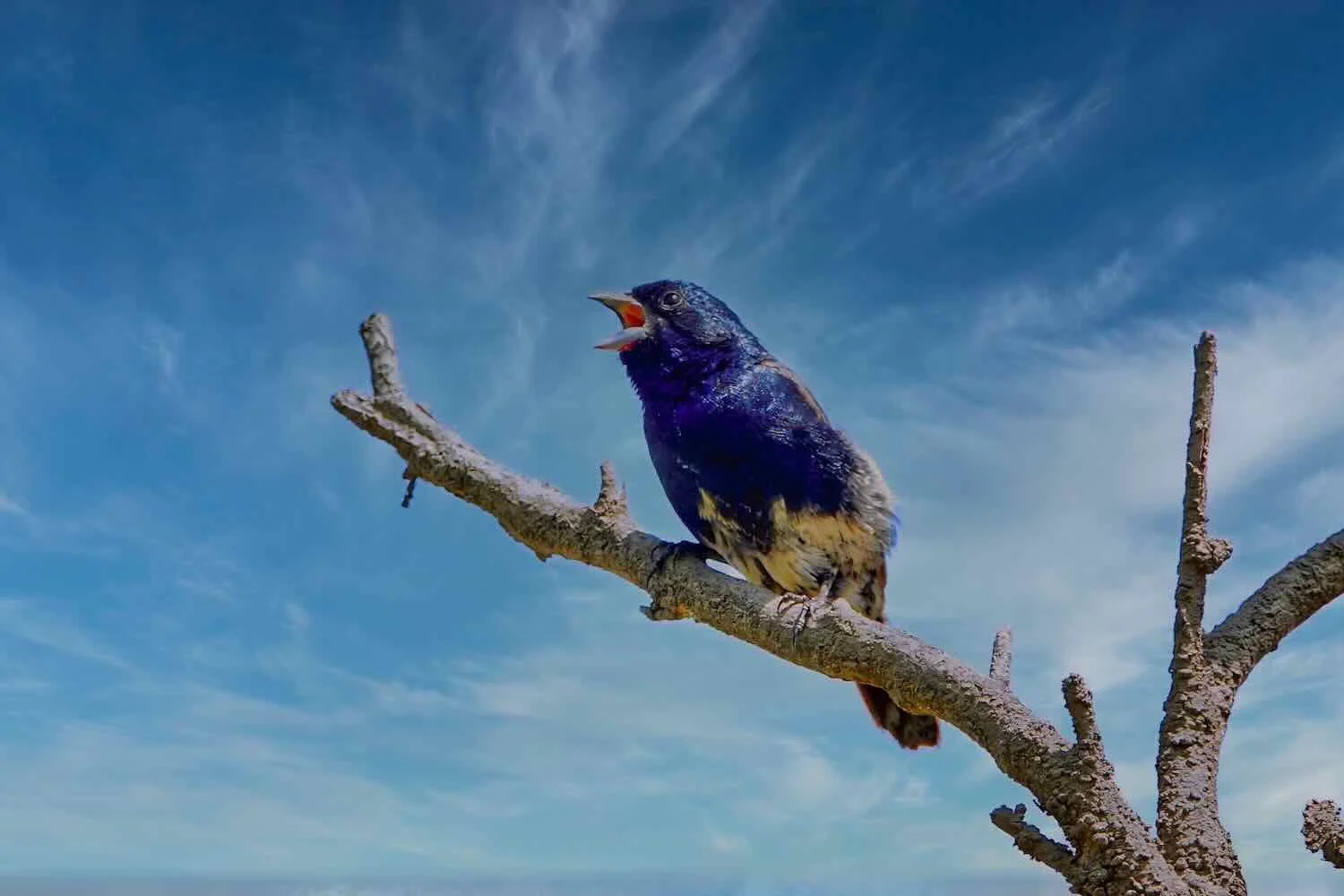
Boldly-colored Peruvian Meadowlarks made an appearance, attracted by all the lush vegetation. Near Pedregal, Pan-American Highway, Lima Department, Peru. Copyright © 2019-2026 Pedals and Puffins.
Easy access to fruit at roadside stands was one of the pleasures we had missed since leaving Colombia. So we were thrilled to see that here, north of Lima, fresh fruit stands were popping up along the side of the road again. When you’re hot and sweaty from cycling under the tropical sun, nothing quite hits the spot like a slice of freshly cut pineapple, watermelon or mango. After 3.5 hours of cycling, we took a long break to savor a couple of big, juicy slices of pineapple purchased from a roadside vendor. It was heavenly.
The bountiful produce for sale at a roadside fruit vendor. They grew a huge variety of fruits in the fields north of Huacho. Primavera, Pan-American Highway, Lima Department, Peru. Copyright © 2019-2026 Pedals and Puffins.
Selecting the perfect fruit snack from a small roadside, fruit stand. Supe, Pan-American Highway, Lima Department, Peru. Copyright © 2019-2026 Pedals and Puffins.
A big, juicy slice of pineapple was just the thing to revive our spirits during a hot afternoon of cycling. Supe, Pan-American Highway, Lima Department, Peru. Copyright © 2019-2026 Pedals and Puffins.
Upon arrival in Paramonga (pop. 20,300), we hit a bit of a snag when we couldn’t find our hotel. Both Google Maps and the point the hotel proprietors had sent to us on Waze showed the hotel in the same place, but we couldn’t find anything at that spot that even remotely resembled a hotel. On the contrary, the point on the map was right in the middle of a residential area comprised of nothing but homes.
Step one was to ask for help. We approached a very nice woman, who seemed unsurprised that we were looking for a hotel, and confidently told us that it was down a small alley. But having walked back and forth down that alley twice already, we still couldn’t find anything that looked like a hotel.
There was a little city park nearby. So step two was for PedalingGuy to stay there with the bikes, while PedalingGal went hunting for the hotel. She went back through the alley, and all around the nearby city blocks. But she still came up empty handed.
By that point we reached the conclusion that there was no way we would find the hotel by ourselves. We sat down on a park bench and sent a message to the hotel from our phone. Miraculously, someone replied right away. She did not seem the least bit surprised that we were lost. Graciously, she said to wait where we were, and that she would come to the park to get us. We were saved!
Moments later a woman emerged from the same alley that we had walked up and down at least four times. She waved to us, and signaled that we should follow her. In the end, the hotel was located in that narrow, little alley after all. However, there was no business sign or any other indication that one of the houses was actually a hotel. Nothing. We would never have found it on our own.
This is the narrow alley, right outside our hotel. There were no signs to indicate that a hotel was there, or which building it might be. (This photo was taken the next morning, after heavy rain fell over night.) Paramonga, Lima Department, Peru. Copyright © 2019-2026 Pedals and Puffins.
We spent a quiet afternoon exploring the town. On our way to the plaza, we encountered what initially could have passed for a street party. But in reality it was a funeral procession. As we approached, a live band was playing and everyone was dancing. Even the four guys carrying the casket “danced” by swaying back and forth to the music and shuffling their feet. A couple of the women carried a large, colorful poster of an older woman, who we guessed was the one who had passed away. Although it was definitely a serious occasion, everyone seemed happy, smiling and waving to onlookers (like us). It was a pleasure to see them celebrating the life of their loved one.
A lively funeral procession - complete with marching band and dancing - made its way down the main street in Paramonga. Lima Department, Peru. Copyright © 2019-2026 Pedals and Puffins.
For a town of its size, Paramonga had surprisingly few restaurants, and we had to wait until the late evening for a restaurant to open so we could eat. The most promising restaurant in town was a rotisserie chicken place, located on the second floor of a building near the central plaza, serving the usual roasted chickens, fries and salad. That was fine for us. We quenched our thirst with a carafe of deep purple “chicha morada” - one of the most traditional beverages in Peru. Made from boiling purple corn with pineapple and spices, chicha morada has been a delicious, staple drink in the Andes for thousands of years.
It might look like wine, but it’s actually “chicha morada” - one of Peru’s most famous drinks! We shared a carafe of this black corn and pineapple beverage, which is similar to what Andean people have been enjoying for 5,000 years. Paramonga, Lima Department, Peru. Copyright © 2019-2026 Pedals and Puffins.
A Couple of Nights Near the Ocean
During the night we stayed in Paramonga it rained, a lot. We had dodged a few light showers here and there since leaving Chile, but for the most part we had enjoyed gloriously dry weather. So when we awoke to wet roads and puddles, it was something of a shock to our systems.
In fact, a key reason we were traveling along the coast of Peru was to avoid the rainy season - with its dangerous electrical storms - which was currently soaking the high mountains to our east. Lighting can be particularly dangerous in the mountains because there is no shelter. A human riding a bicycle is often totally exposed, given the lack of any vegetation higher than your ankle. In fact, just a week earlier we had heard that a cyclist from Germany was killed in his tent by a lighting strike in the mountains of Peru, not all that far from us.
Unfortunately for us, the rain had turned the surface of the dirt road leading out of town into a layer of slimy mud. With each pedal stroke, the mud splattered up onto our (previously clean) bikes, panniers, and clothes. Passing cars splashed us with even more muddy water. Gobs of the sloppy, black muck stuck to our bike frames and shoes, and eventually got smeared all over our legs.
PedalingGal did not like the looks of that slimy, muddy road. An overnight rain had turned our exit from town into a slippery mess. Near Paramonga, Lima Department, Peru. Copyright © 2019-2026 Pedals and Puffins.
By the time we reached the paved highway, we were filthy. Luckily, the asphalt road dried quickly, so we didn’t have to contend with road splash for much longer.
One of the highlights of the day’s ride came just a short distance up the road. Although Peru is home to thousands of pre-Columbian archaeological sites, only a small handful of them are visible from major roads (e.g., the Nazca Lines south of Lima). When traveling by bicycle, it isn’t very tempting to detour many miles off your route to visit out-of-the-way ruins, especially if that involves a lot of climbing. So we appreciated it when sights were close to our route.
Just north of Paramonga, we stumbled upon the “Paramonga Fortress” - a massive pyramid-like structure crafted by the Chimú culture about 700 years ago to shield themselves from the advancing Incas. Sadly, it didn’t work, and the fortress was later taken over by the Incas. The pyramid was conveniently located right next to the Pan-American Highway, making it a simple and fascinating stop on our journey. We spent some time exploring the base of the ruin, marveling at its towering adobe walls.
The southern wall of the main pyramid at the Paramonga Fortress Archaeological Site. Pan-American Highway, Lima Department, Peru. Copyright © 2019-2026 Pedals and Puffins.
Just north of the Paramonga Fortress Archaeological site we spotted a massive Tyrannosaurus rex near a tower on top of a ridge. The dinosaur was a statue at the Paltarumi gold-processing plant, just over the hill. Paltarumi provides gold processing services to small and medium-scale miners throughout the region. N of Paramonga, Pan-American Highway, Lima Department, Peru. Copyright © 2019-2026 Pedals and Puffins.
Once we had passed the “fortress,” the lush agricultural landscape disappeared, and we were once again surrounded by sand and rocks. However, in a couple of places there were some more signs of change. About halfway through the day, we passed some dry gullies dotted with clumps of columnar cacti. There was only one species of cactus, and absolutely nothing else growing there. It’s always fascinating to see a plant growing where apparently nothing else will.
Soon after that we rode through an area where there were giant sand dune fields piled high along the mountains. Yet the valley floor was covered with clumps of vegetation. It was striking to see so much plant life away from the irrigated fields.
Once we left the fertile, irrigated fields near Paramonga, the landscape returned to desert. S of Gramadal, Pan-American Highway, Ancash Department, Peru. Copyright © 2019-2026 Pedals and Puffins.
These clumps of cactus (Haageocereus pseudomelanostele) caught our eye, because they were literally the only plants growing on these loose, barren slopes. S of Gramadal, Pan-American Highway, Ancash Departmen, Peru. Copyright © 2019-2026 Pedals and Puffins.
Later we cycled into a flat valley brimming with clumps of vegetation - a rare sight along the coast of Peru. Gramadal, Pan-American Highway, Ancash Department, Peru. Copyright © 2019-2026 Pedals and Puffins.
We had one last, big climb towards the end of the day. Luckily, once we reached the summit we were able to coast down a long descent to our destination. Near Playa Gaviotas, Pan-American Highway, Ancash Department, Peru. Copyright © 2019-2026 Pedals and Puffins.
We spent the next couple of days hanging out in the low-key town of Huarmey (pop. 16,000). Located within walking distance of the coast, Huarmey attracts Peruvian visitors who are looking for a more rural, uncrowded, and laid-back beach getaway. Best of all, we were able to find one of those very rare treats - a hotel with air conditioning.
Huarmey bills itself as La Ciudad de Cordialidad (“the city of cordiality”) - emphasizing its friendly and welcoming personality. Huarmey, Pan-American Highway, Ancash Department, Peru. Copyright © 2019-2026 Pedals and Puffins.
One morning we took a walk down the sandy access road to the beach, passing through agricultural fields in various stages of planting. In several places the farmers were out tending their fields. We passed some guys hoeing the soil with hand tools. Further down the trail another guy was irrigating a field by directing water through shallow trenches, using just a shovel to block the water and send it where he wanted it to go. It was a low tech but effective way to irrigate. There was no mechanization on these farms.
The rural beaches near Huarmey were accessed via a sandy road that passed among agricultural fields. Path to Manache Beach, Near Huarmey, Ancash Department, Peru. Copyright © 2019-2026 Pedals and Puffins.
Even though it was a Saturday morning, the beach itself was deserted when we arrived. We literally were the only ones there. Without any crowds the beach was full of wildlife, from bright orange ghost crabs, to flocks of seabirds. Two big cargo ships were anchored offshore, perhaps waiting to be loaded with minerals or agricultural products at one of the deep-water ports just to our south. It was pleasant just strolling along the quiet shoreline, hearing only the wind, waves, and occasional cry of a bird.
Bright orange, Painted Ghost Crabs were common. They would sit at the entrance to their sandy burrows, and dart underground if you got too close. We experienced this taunting behavior multiple times as we tried to get close enough for a photo. Manache Beach, Near Huarmey, Ancash Department, Peru. Copyright © 2019-2026 Pedals and Puffins.
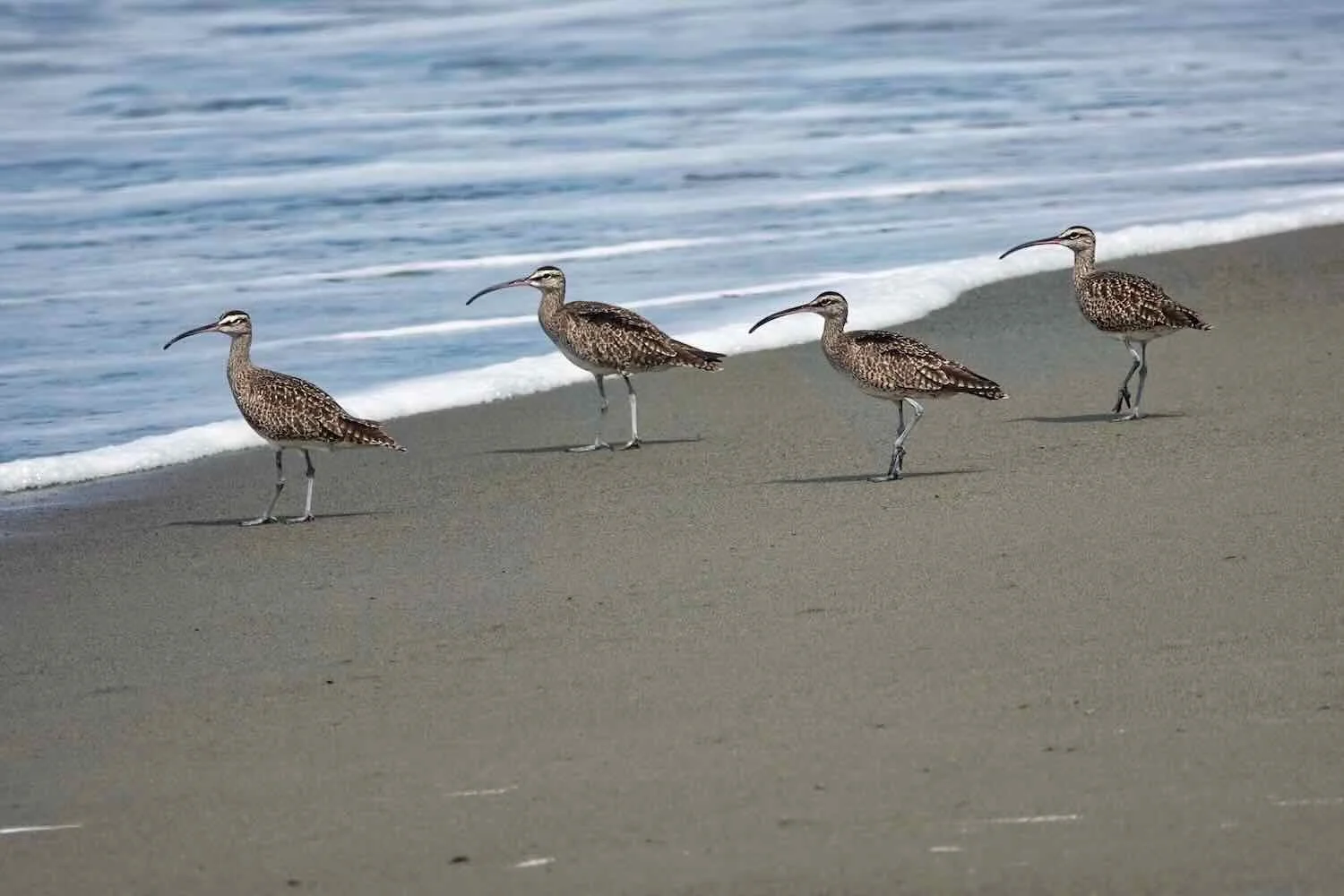

One of the big ships anchored offshore was the “Mottler,” a dry bulk carrier designed to haul unpackaged grain or mineral ore (both common exports from the nearby port). According to the internet, not long after we spotted it in Peru, the Mottler steamed northward to Canada, via the Panama Canal. Manache Beach, Near the Port of Huarmey, Ancash Department, Peru. Copyright © 2019-2026 Pedals and Puffins.
After Huarmey, our next destination was the little, coastal village of La Gramita. The landscape continued to be sandy desert, but this section was considerably more remote. Once we had left the streets of Huarmey behind, we didn’t pass any other human settlements for many miles.
The road from Huarmey to La Gramita was much like previous rides on Peru’s northern coast - with a couple of big mountain passes through mostly empty landscapes. The lack of vegetation itself becomes an interesting feature. S of La Gramita, Pan-American Highway, Ancash Department, Peru. Copyright © 2019-2026 Pedals and Puffins.
In the lower valleys we continued to see a lot of sand mounds capped with a dense growth of scrubby plants. S of La Gramita, Pan-American Highway, Ancash Department, Peru. Copyright © 2019-2026 Pedals and Puffins.
The village of La Gramita (pop. ~300) doesn’t lie along the Pan-American Highway. Instead it sits a little over a mile to the west, nestled within a natural cove. After 4+ hours of cycling, we reached the junction for the turn towards La Gramita, marked by a sign bearing the village’s name, flanked by a fisherman and an anchor.
It was a good thing that the road to La Gramita was mostly downhill, because of the wind. The strong, afternoon winds blew inland from the ocean, which meant we were now cycling directly into a nasty headwind. Even with the downhill gradient, we had to pedal hard to finally reach the town.
This sign marked the turnoff from the highway towards the little, fishing village of La Gramita. Pan-American Highway, Ancash Department, Peru. Copyright © 2019-2026 Pedals and Puffins.
Fifteen minutes later we arrived at the gates to the village. La Gramita, Ancash Department, Peru. Copyright © 2019-2026 Pedals and Puffins.
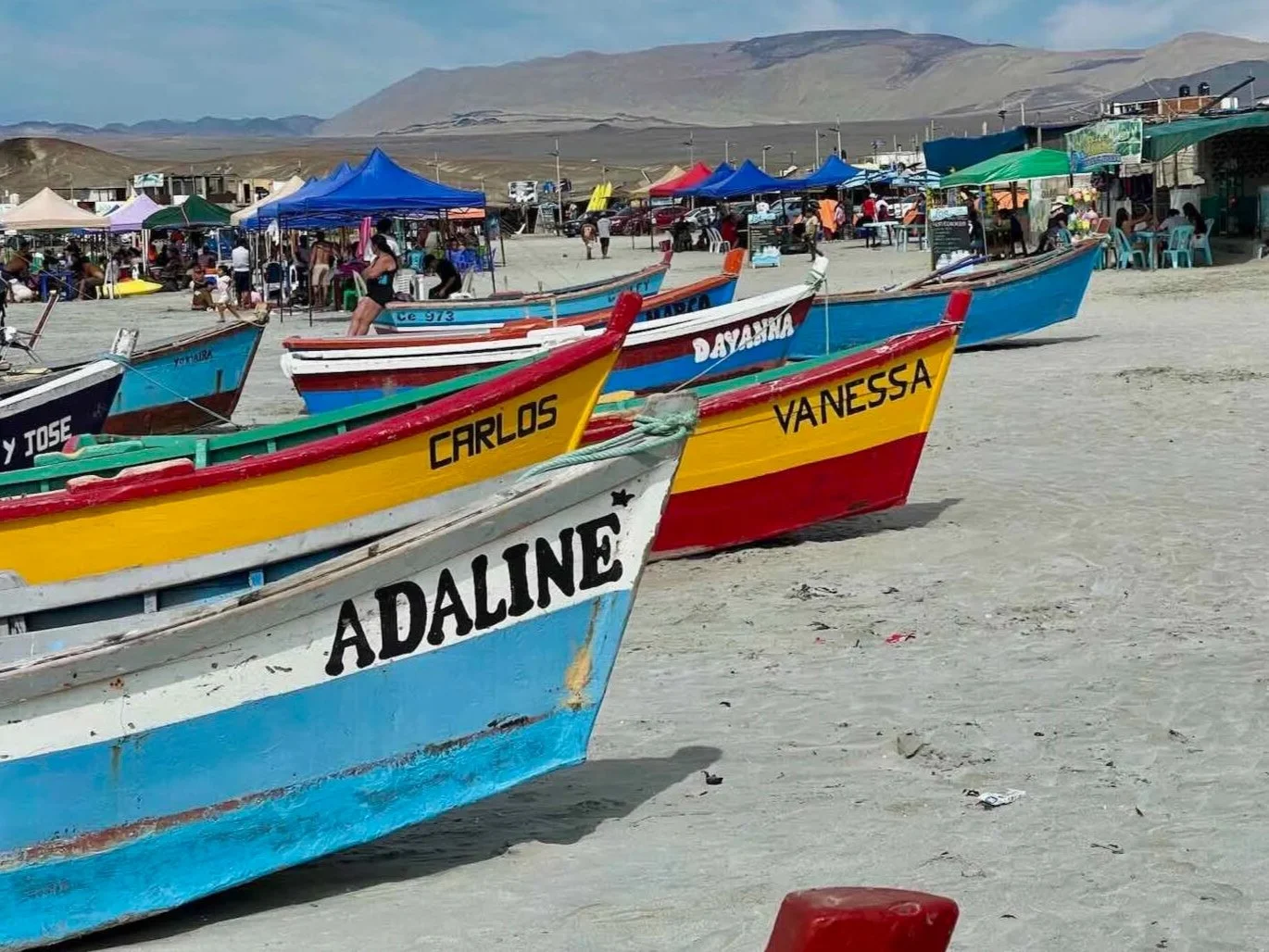
La Gramita was primarily a fishing village. But it was Sunday afternoon, so the beach at the head of the cove was crowded with families, swimming in the calm waters and playing in the sand. Nearby, roughly 20 wooden fishing boats were beached on the sand. Yet wherever there was space, families had erected shade tents to stake out their spot for an afternoon at the beach.
After a leisurely lunch along the waterfront, we went for a walk along the beach. At the end of the cove the surf crashed into a rocky reef, running up channels between the stones. We had to stay alert to avoid getting splashed with seawater. Crabs, shorebirds, and even an iguana lurked among the rocks, hunting for morsels brought in by the tide.
A small flotilla of wooden fishing boats was beached onshore at the head of La Gramita Cove. Yet wherever there was space, families gathered under shady awnings to enjoy an afternoon of swimming and playing in the sand. La Gramita, Ancash Department, Peru. Copyright © 2019-2026 Pedals and Puffins.
Our first order of business was to grab some lunch at one of the small restaurants facing the waterfront. Many Peruvian restaurants serve “cancha” (large-kernel corn that has been roasted in oil and garnished with salt) as a crunchy appetizer while you wait for your meal. La Gramita, Ancash Department, Peru. Copyright © 2019-2026 Pedals and Puffins.
Dozens of wooden fishing boats were anchored out in the cove, safely away from the rocky shoreline. La Gramita, Ancash Department, Peru. Copyright © 2019-2026 Pedals and Puffins.
This Peru Pacific Iguana rested on one of the rocks near the shore. La Gramita, Ancash Department, Peru. Copyright © 2019-2026 Pedals and Puffins.
Although the restaurants near the beach benefitted from tourism, the major economic driver in La Gramita was artisanal fishing - supported by Peru’s rich marine resources. These two guys were likely fishermen, resting on and repairing their nets at the end of the day. La Gramita, Ancash Department, Peru. Copyright © 2019-2026 Pedals and Puffins.
That evening we ate our dinner on the roof of our hotel as the sun set slowly beyond the anchored boats, in a blaze of orange light. La Gramita, Ancash Department, Peru. Copyright © 2019-2026 Pedals and Puffins.
Melting In the Heat
It turned out to be a very good thing that our next day’s ride was the shortest we’d had since departing Lima, because the clouds - which usually kept the temperature tolerable for cycling - burned off by 7:30am, exposing us to the full intensity of the equatorial sun.
The elevation profile for the day’s ride was shaped like a capital “A” - with about 10 miles (16 km) of climbing in the first half, and the final 10 miles mostly downhill. Ordinarily that would have been ideal, because we could get most of the climbing done before the day became too hot. But with only about an hour of cycling before the clouds disappeared, it just wasn’t enough. We sweated a lot while grinding our way up that hill.
The climbing began right out of the gate, as we headed uphill from La Gramita to reunite with the Pan-American Highway. Fortunately, the coastal mist still hugged the land for the first hour of our ride, and we had a pleasant start to the day. Near La Gramita, Ancash Department, Peru. Copyright © 2019-2026 Pedals and Puffins.
Before long the clouds had burned off, and we were cycling under a baking sun. The sand dunes that surrounded us seemed to amplify the heat. S of Casma, Pan-American Highway, Ancash Department, Peru. Copyright © 2019-2026 Pedals and Puffins.
The lowlands around the town of Casma were another irrigated oasis. This mango orchard was just one of many types of crops we passed on our way into town. Near Casma, Pan-American Highway, Ancash Department, Peru. Copyright © 2019-2026 Pedals and Puffins.
By the time we arrived at our hotel in the town of Casma (pop. 42,200) the sun was blazing and we were wilting from the heat. Sadly, our hopes for a reprieve were dashed when we discovered that the rooms in our hotel were not well suited for comfort on a hot day. The only window in the room opened onto an internal hallway, providing no circulation of fresh air. There was no air conditioning, so the room was incredibly stuffy and hot. It was also rather small. We managed to get both bicycles inside, but it was definitely crowded.
After washing off the grime from the road, we just lay down inside the oven-like room with the fan on full blast. It’s times like that which make you appreciate why people in warmer climates traditionally take afternoon siestas.
When we finally went out to search for dinner, we were waylaid by an ice cream parlor. There were two shops near the central plaza selling big fruit salads with scoops of ice cream on top. Both places were crowded with locals, all using ice cream to cool off in the hot afternoon. We joined them, ordering fruit salads with double scoops of ice cream. It was perfect.
When we returned to the hotel room it was still stiflingly hot. We spent the rest of the evening just laying limply on our bed, with all the windows and doors open, and the fan blasting like a jet engine.
Gladdened by the Return of the Clouds
We spent a rough night in that hotel room, primarily because it stayed uncomfortably hot all night. When we crawled out of bed at 5am, we both were pretty sleepy.
However, that day our luck took a turn for the better. The sun remained behind a thick layer of clouds in an overcast sky - giving us 2.5 more hours of cooler temperatures than the day before. It was awesome.
From the top of a high pass we could see the Pacific Ocean, shrouded in sea mist. Near Tortuga, Pan-American Highway, Ancash Department, Peru. Copyright © 2019-2026 Pedals and Puffins.
Everything was going beautifully until the final stretch of road into the city of Nuevo Chimbote. When we turned off of the freeway the road conditions deteriorated. There still was a paved shoulder, but it was buried under several inches of sand. The traffic was coming pretty thick and fast, so we were forced to cycle on the sandy shoulder. Each pedal stroke became a chore, and our pace slowed dramatically. On the bright side, our reward at the end was a hotel room with air conditioning. As the afternoon temperature soared, that was a true gift from heaven.
A Shiny New City
The city of Nuevo Chimbote (pop. 190,000) had a completely different character than other towns along the coast of Peru. Without even knowing anything about its history before our arrival, we were struck by the clean (bordering on sterile), modern feel of the city. There was no fading, old architecture, no cobblestone alleys, and definitely no tuktuks. Instead the wide avenues were lined with sleek shopping malls, eye-catching public art, and airy public parks. There had to be a story behind all this modernist gloss.
It turned out that Nuevo Chimbote was truly a new city. Like a phoenix arising from the ashes, Nuevo Chimbote got its start soon after its neighbor, the original Chimbote, was devastated by the Great Peruvian Earthquake of 1970. That 7.9 magnitude earthquake destroyed 80-90% of the buildings in Chimbote, leaving untold thousands of people homeless. In response, many of Chimbote’s citizens moved into tent cities to the south, in the area that would eventually become Nuevo Chimbote.
Reconstruction took time, but with tremendous civic determination Nuevo Chimbote built a new city from scratch that was formally recognized as its own district in 1994. Many of the buildings in the central area where we stayed were built in just the past 20 years - resulting in the fresh, modern look. As we walked around the central commercial area after dinner, we could feel the positive energy that has caused the city’s population to explode by 250% in just the past ten years.
Oversized flamingo statues graced a busy intersection near the big shopping mall. Nuevo Chimbote, Ancash Department, Peru. Copyright © 2019-2026 Pedals and Puffins.
The towering Nuevo Chimbote Cathedral glowed on one side of the Plaza Mayor. It was built in the old Spanish style, but was completed just 18 years ago. The plaza where it sits is actually the largest in Peru, brimming with new landscaping and public art. Plaza Mayor, Nuevo Chimbote, Ancash Department, Peru. Copyright © 2019-2026 Pedals and Puffins.
Near the plaza we found a shop selling fruit salads topped with ice cream. The fruit in the salad was varied and super fresh - absolutely delicious (we’re starting to make a habit of enjoying these treats). Nuevo Chimbote, Ancash Department, Peru. Copyright © 2019-2026 Pedals and Puffins.
As the sun set, people headed over to a local carnival that sparkled with colorful lighting, just a block from the main plaza. Nuevo Chimbote, Ancash Department, Peru. Copyright © 2019-2026 Pedals and Puffins.
One of Those Days That’s Easier Than Expected
Before setting out the next day, we were a little bit nervous about the bike ride from Nuevo Chimbote to Chao. Several factors seemed like they would add up to a tough day of cycling. For example:
The road into Nuevo Chimbote had been challenging, and we did not relish the idea of more cycling on the sandy road shoulder.
There was a tunnel on the highway ahead that we considered detouring around. You never know with tunnels. Sometimes they are well lit with nice margins, and other times they are death traps with no light and just barely enough room for the cars (and nothing else).
At nearly 50 miles (80 km) it would be a long day of mountain cycling, with one particularly high pass that would come in the second half of the ride.
But right out of the gate, things went better than expected. For the first hour, we were able to cycle on bike lanes that were protected from the traffic - totally avoiding that sandy road shoulder.
When we reached the tunnel, we discovered that it wasn’t that long, it was well lit, the gradient inside was downhill, and - best of all - it had a paved sidewalk throughout its entire length that kept us out of the traffic lane. In truth, it was considerably easier than cycling through most of the tunnels we had encountered on this trip. We were glad we hadn’t added miles by trying to detour around the tunnel. Even climbing over the big pass ended up being pretty easy. It’s always awesome when things work out that way.
This little dog found a safe, comfortable resting spot on a horse cart, in the shade of some freshly cut sugarcane. We called out to him, but in contrast to most dogs who want to chase us and give us more attention than we desire, he didn’t want anything to do with us. Guadalupito, Pan-American Highway, La Libertad Department, Peru. Copyright © 2019-2026 Pedals and Puffins.
Horses still do a lot of the work in some rural communities. This guy and his horse were hauling a big load of brush. Guadalupito, Pan-American Highway, La Libertad Department, Peru. Copyright © 2019-2026 Pedals and Puffins.
As we climbed over the big pass of the day, we saw dark clouds hanging low over the mountains not far to our east. It looked like it was raining in the highlands - a good reason to be cycling along the desert coast. S of Chao, Pan-American Highway, La Libertad Department, Peru. Copyright © 2019-2026 Pedals and Puffins.
Chao (pop. 12,100) was another sleepy, agricultural town with deep historical roots. The town’s relatively small footprint, nestled within an expansive landscape turned green by irrigation, reminded us of some of the southern towns we had passed though when we first reached the Peruvian coast. However instead of rice, this valley was covered with a shaggy carpet of sugarcane that was grown on industrial-scale farms, primarily for export. As we descended into the Chao valley, fields of sugarcane stretched all the way from the highway to the distant foothills of the Andes - where they abruptly stopped at the base of the sand dunes.
The town itself had a modest central district, centered around a small but tidy plaza. The most notable landmark was the Church of the Redeemer’s Cross, which sat on one side of the plaza. With a well-kept exterior and fresh coat of paint, the church stood in stark contrast to the weather-beaten facades of all the other buildings in town. We later learned that this was a new church, just completed in 2014, and that it was the pride of the city.
Industrial-scale farms of sugar cane stretched all the way to the foothills of the nearby mountains, more than 3 miles (5 km) away. Near Chao, Pan-American Highway, La Libertad Department, Peru. Copyright © 2019-2026 Pedals and Puffins.
The new Church of the Redeemer’s Cross was the pride of the town, brightening up one side of the central plaza. We started to notice that all of the churches in this part of Peru were painted using the same color scheme of mustard yellow, trimmed with white. Chao, Pan-American Highway, La Libertad Department, Peru. Copyright © 2019-2026 Pedals and Puffins.
Other parts of this scruffy agricultural town looked a little more weather-beaten. Chao, Pan-American Highway, La Libertad Department, Peru. Copyright © 2019-2026 Pedals and Puffins.
Unfortunately, the final day of cycling into the city of Trujillo ended up being a bit more difficult than we had expected. It started at 4:15am when the rooster next door decided that it was time for everyone in the neighborhood to wake up. There was no more resting after that. We were out of bed by 4:30am, and on the road a little after sunrise. Thank you rooster!
However, the biggest challenge was the sun. During yesterday’s ride, we had the benefit of a thick cloud layer most of the day. But on the ride into Trujillo, all the clouds had burned off by 7:00am, and the sun shone brightly for the rest of the day. The intense solar radiation caused the temperature to soar.
Dehydration became a serious concern. We chugged fluids throughout the morning, but on the final hill PedalingGal ran out of gas. PedalingGuy noticed that she was falling behind, and stopped to wait. Yet when she finally caught up with him she was dizzy and panting, unable to catch her breath. She sat down by the side of the road and quickly polished off 1.5 L of fluids, garnished with a salt tablet. After a 10 minute rest, she finally started to feel better and was able to finish the ride.
The other bit of excitement came when we entered the city’s urban zone. Trujillo (pop. 1.06 million), is Peru’s third largest metropolitan area. As you might expect from a country that has some of the most notoriously bad traffic in the world, cycling on the roads of Trujillo required nerves of steel.
For many miles on the approach to the city, the road shoulder was lumpy sand and gravel. And the final 45 minutes devolved into a series of wild traffic circles where there seemed to be no rules - just a lot of improvisation. The colectivo vans and tuktuks were a particular menace, often pulling over and stopping right in front of us - causing us to brake suddenly to avoid rear-ending them. We were very relieved to finally arrive at our hotel, and leave the insane traffic behind.
A Bit of Bike Maintenance
Since we had left Lima, a few things started to go wrong with our bikes. The biggest problem was PedalingGuy’s seat post. Just one day after departing Lima, he began having a serious problem with his seat post sliding down into the seat tube, sinking lower and lower as the day went on. In addition to being uncomfortable, cycling with the wrong saddle height is bad for your knees, causing pain and even injury if it’s not addressed.
There were multiple problems here. The first was that the bolt used to tighten the seat post clamp had become stripped, rendering it unable to fully tighten the clamp. We had some spare bolts that were the right diameter, but were a little bit shorter than the original bolt. We swapped out the original bolt for a shorter, new one and that helped slow the slippage - but it didn’t fully fix the problem.
In addition, the seat post had previously been lubricated with the wrong kind of grease. It is very important to grease your seat post so that it does not fuse to the seat post tube. We have heard some real horror stories about bikes having to be trashed because the seat post became permanently stuck inside the tube. We even had a bike mechanic in Istanbul tell us that the most difficult repairs he had to do involved extracting stuck seat posts.
Unfortunately, when we last greased our seat posts we did not have the special “gritty grease” that is best for the job. Gritty grease has grit (sometimes ground up walnut shells) that provides some friction. It’s an interesting contradiction to use grease that provides friction while at the same time providing lubrication. But the chances of finding the proper grease in the small towns along our route seemed very remote.
Instead, we had bought a plumbing hose clamp from a hardware store in the town of Casma. PedalingGuy had read that you could affix a hose clamp to your seat post above the main clamp, and that could help hold the seat post in place. Once again, it helped to stabilize the saddle a little bit more - but not enough. Each day we had to stop a couple of times during our ride so that PedalingGuy could raise his saddle again.
So now that we were in a bigger city (Trujillo) with some real bike shops, we decided to tackle the problem once and for all. On our first day in town we went to the closest bike shop to our hotel. We tried not to get our hopes up too high, because bike shops in many parts of South America typically don’t have many bike parts on hand.
Amazingly, this bike shop had almost all of the supplies that PedalingGuy was looking for: the correct sized replacement bolt for his seat clamp, AND the “gritty grease” that provides extra friction required to hold the seat post firmly in place. We also decided buy a whole new seat clamp as a backup, in case the new bolt and grease did not fix the problem. Although the shop didn’t have the right sized clamp in stock, they were able to call another shop to have one delivered, so that we could pick it up later that day. We couldn’t believe our luck.
An Unexpected Delay
But you should never get over-confident about how things are going. We had only been in Trujillo for two days when another development completely upended our plans.
The morning began well enough, with a long walk out to another bike shop to look for a new saddle for PedalingGal. By the time we returned to the hotel, PedalingGuy was not doing well. He confessed that he had been having some pain for the past couple of days related to a deep cut he had gotten on his arm. Worse, the skin had become red, swollen and warm to the touch since that morning.
We recognized it as a skin infection, and realized that we should take care of it quickly. So we headed over to one of the city’s medical clinics, figuring that PedalingGuy would get some antibiotics and we’d be good to go.
Not so fast. First of all, the Peruvian clinic system was really slow. We arrived at the clinic around 3:30pm, but we were assigned to see a doctor who didn’t arrive at the hospital until after 5pm.
Then things got crazy. After an examination and some tests, the doctor informed us that the infection was serious, treatment was urgent, and that PedalingGuy needed to be admitted to the hospital immediately to receive intravenous antibiotics. And by immediately, the doctor meant this very instant. Well that was a surprise.
So without being able to go back to the hotel to collect any personal items we climbed three flights of stairs to the attached hospital, where PedalingGuy was admitted and shown his room. By 9pm the same day he was settled into a hospital bed, with an IV drip in his arm. On the bright side, a surgeon who examined PedalingGuy said that surgery would not be necessary. We were relieved about that.
However, we soon came to appreciate that sub-cutaneous skin infections are nothing to take lightly. PedalingGuy spent the next four days in the hospital on the antibiotic IV drip, before finally being released. Even then he had to take four different oral antibiotics, visit the doctor three more times for tests, and stay off the bike for the next 18 days as the infection slowly cleared from his system.
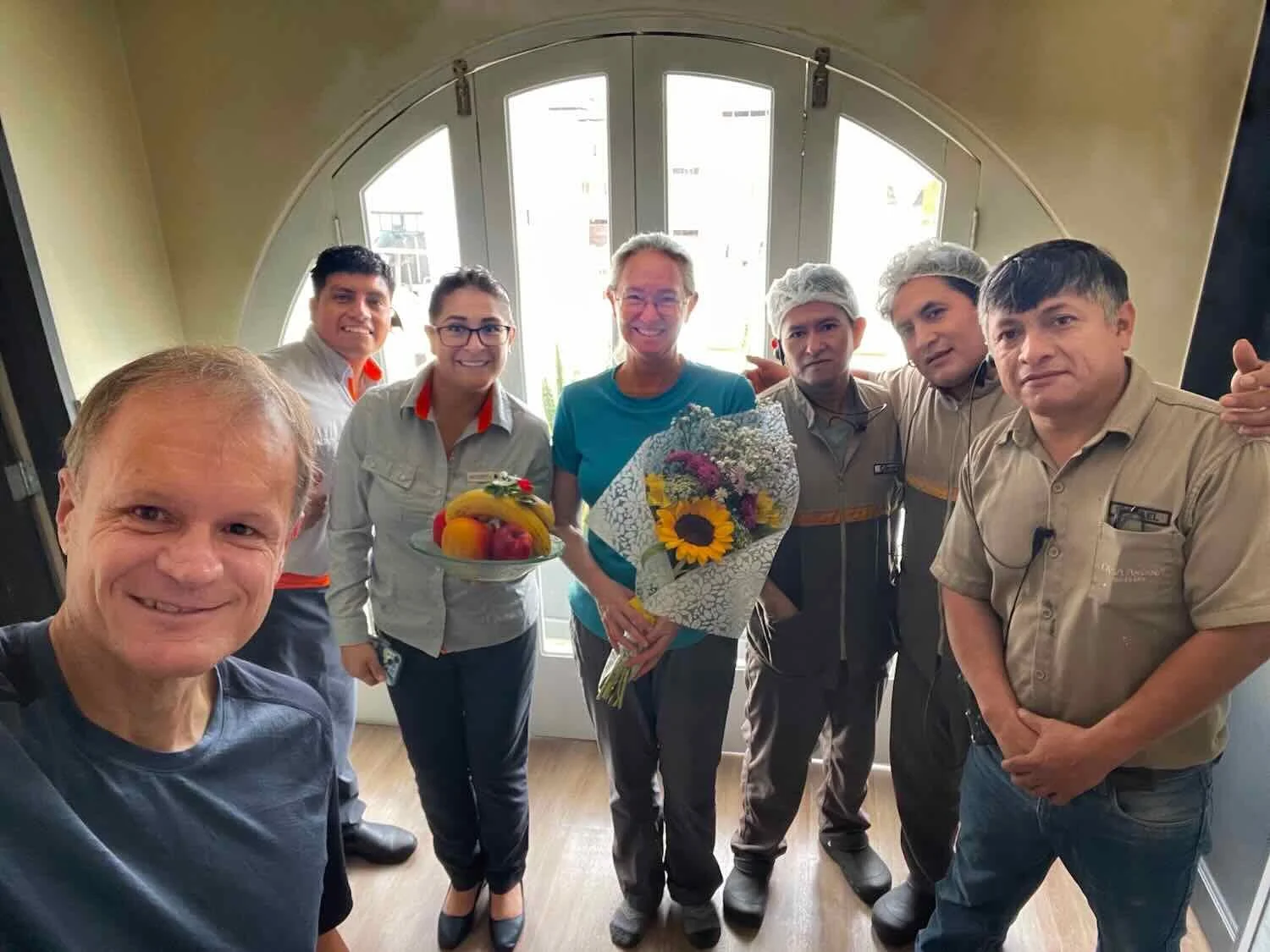
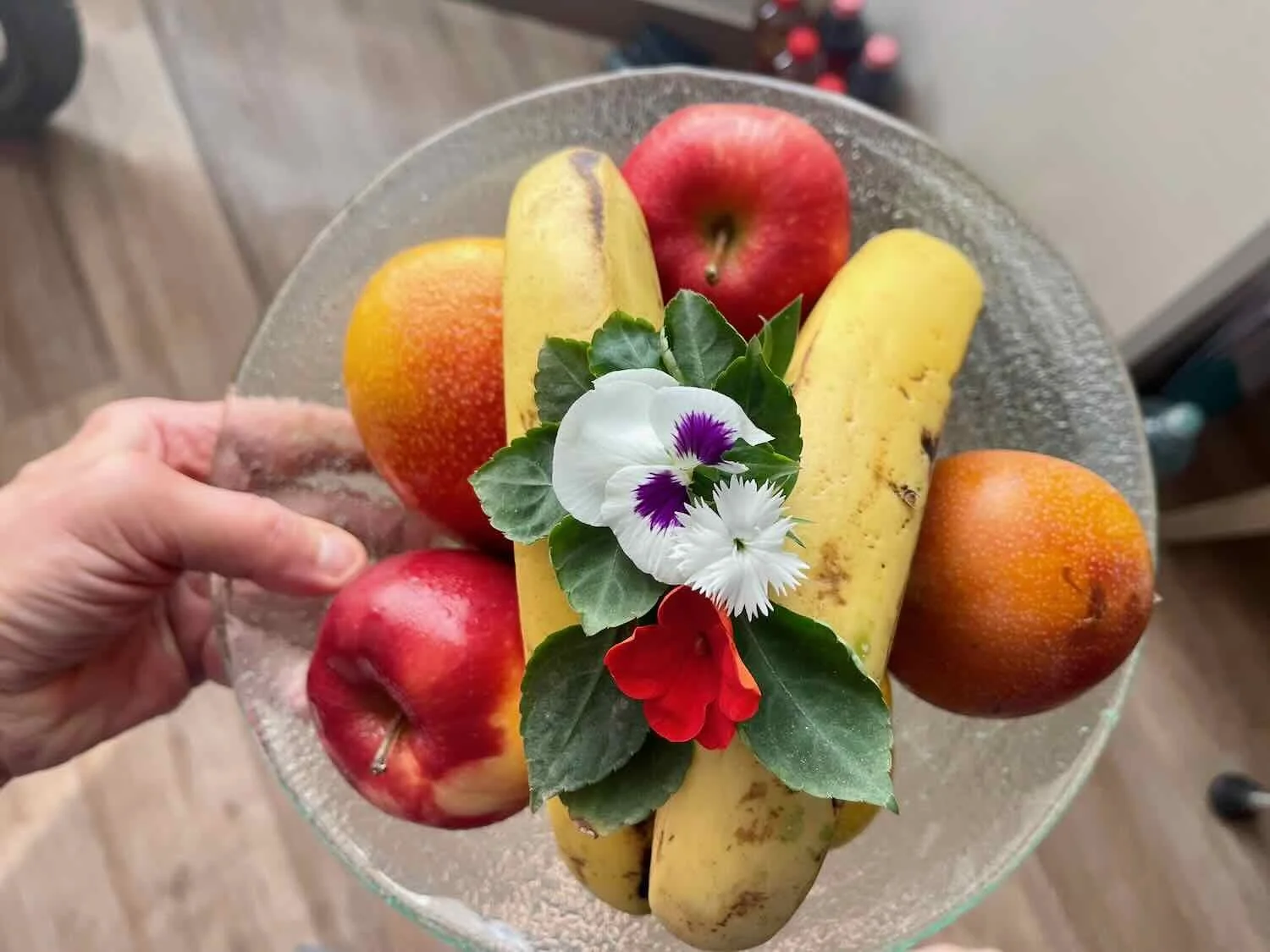
Throughout the whole process, the folks at the hotel where PedalingGal stayed were wonderfully supportive. When PedalingGuy was finally released from the hospital, the hotel staff even brought him a bouquet of flowers and a fruit plate. It was very sweet.
Getting To Know the City of The Marinera
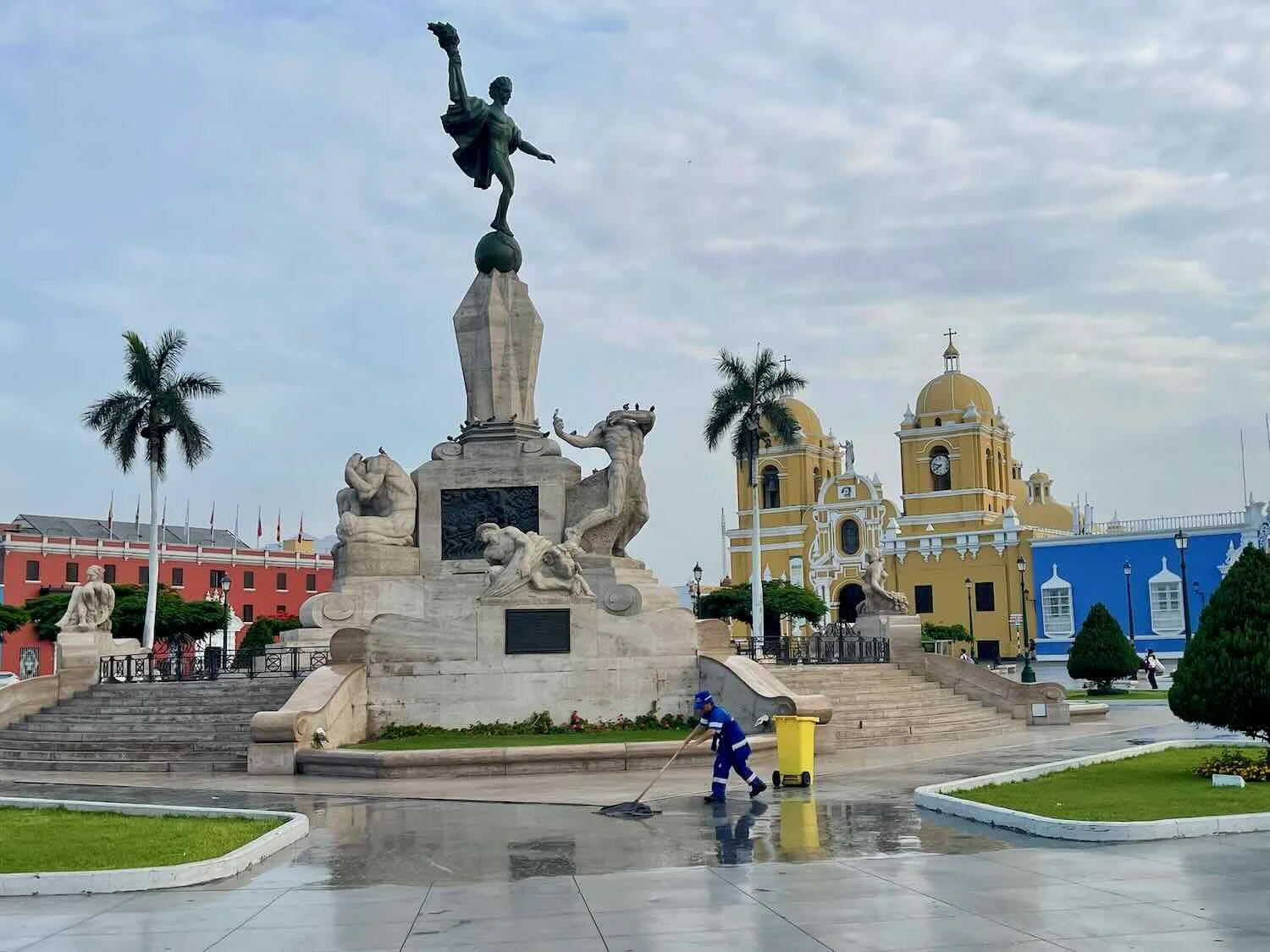
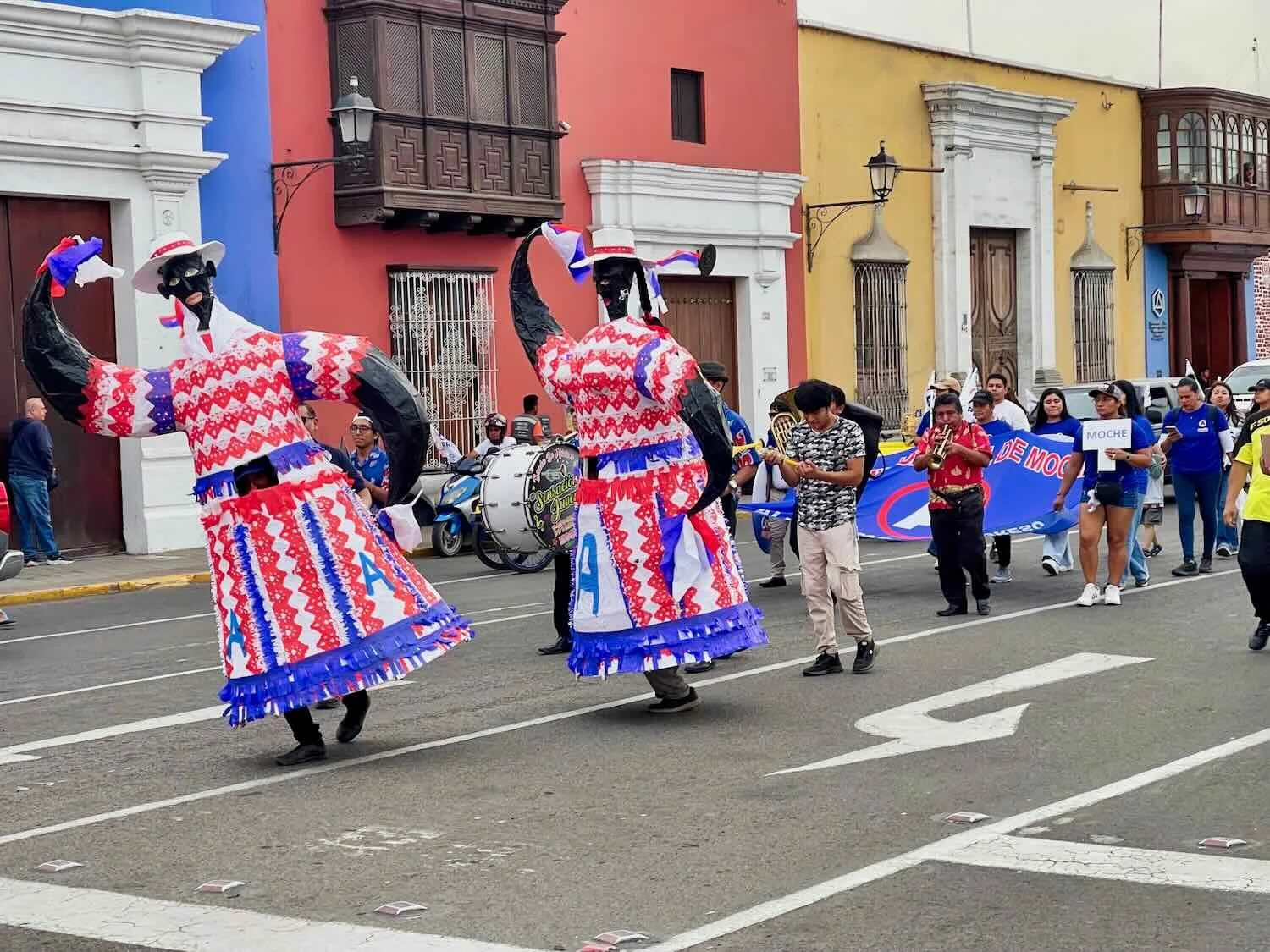
All that time gave us a chance to explore Trujillo, and get to know this vibrant, friendly city. We were fortunate that our lodging was very close to the main plaza, which hums with activity throughout the afternoon and evening as families gather on benches, kids zoom around on scooters or skates, vendors hawk colorful toys and inexpensive snacks, and couples pose for selfies in front of the central monument (not to mention the occasional political rally).
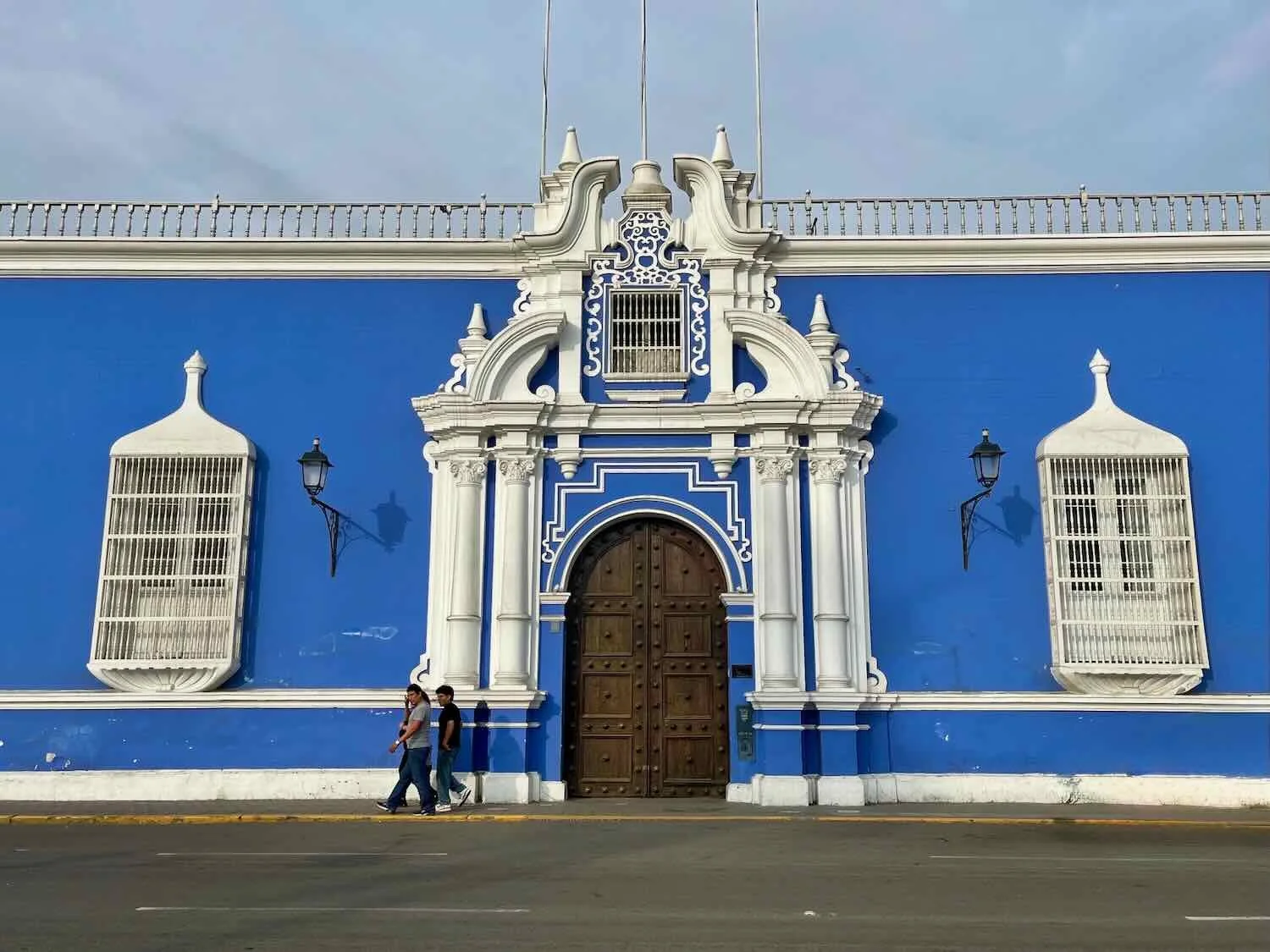
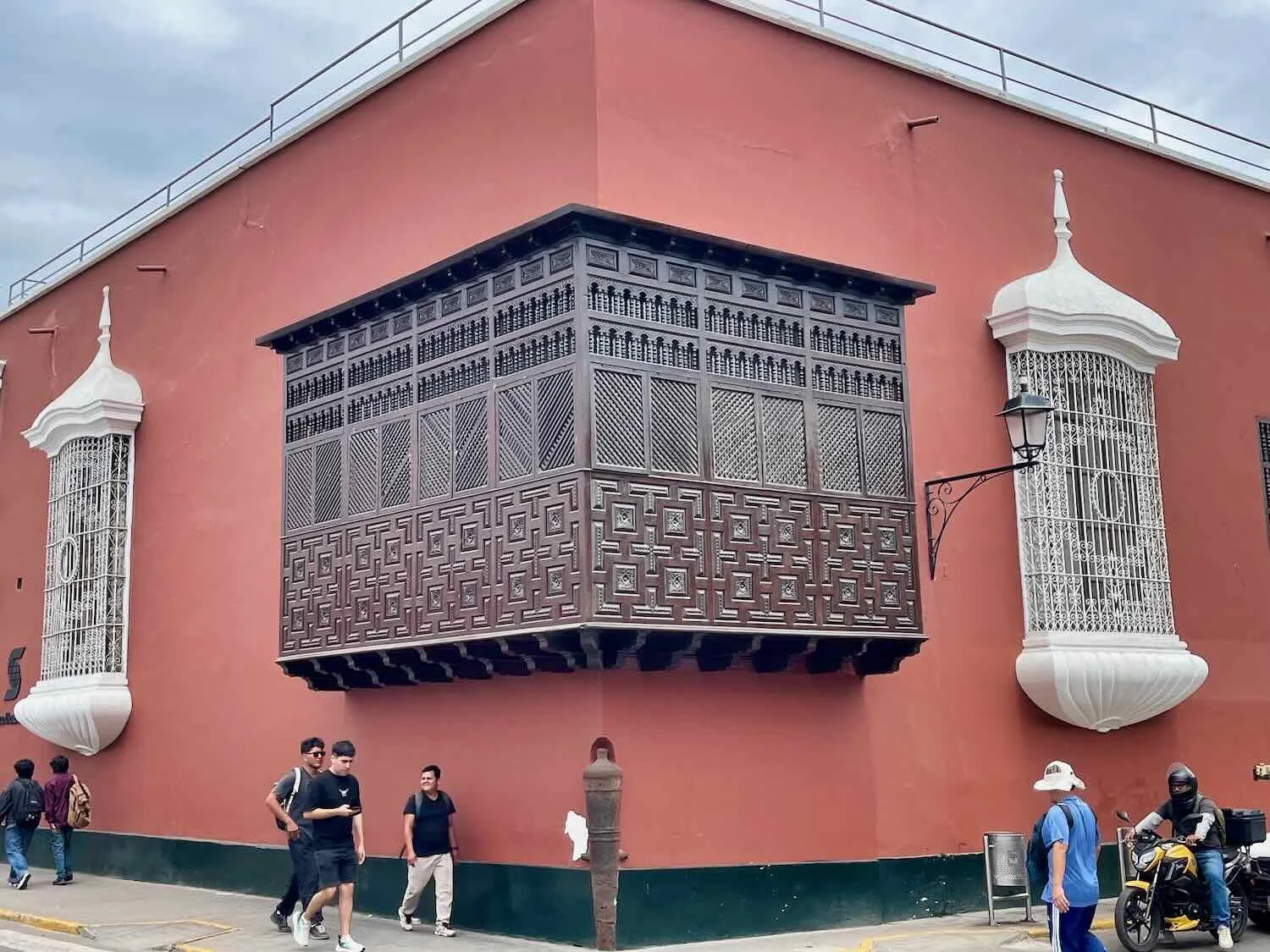
The plaza is one of the oldest in Peru, dating back to the city’s founding in 1534. Its historical roots shine through the picturesque, colonial-style buildings that surround the plaza, each one painted in a bright color with white trim - often enhanced with wooden balconies.
A nearby pedestrian street was one of our favorite places for an evening walk, where street performers entertained the crowds with music, dance and art.
This exuberant band of drummers banged out a tempo on the city’s pedestrian street. Trujillo, La Libertad Department, Peru. Copyright © 2019-2026 Pedals and Puffins.
It’s common in Latin America for businesses of the same type to cluster together. Even so, we had never seen so many barbers crowded on a single street (as evidenced by the many barber poles). Trujillo, La Libertad Department, Peru. Copyright © 2019-2026 Pedals and Puffins.
There’s always someone who thinks they can turn their little hatchback into a cargo truck. The boxes stacked on top of this car looked like they would topple off if the driver made any sudden moves. Trujillo, La Libertad Department, Peru. Copyright © 2019-2026 Pedals and Puffins.
By this time we had become regular consumers of fruit salads topped with ice cream. There are few other foods that so reliably take the edge off of the summer heat and bring a smile to your face. Trujillo, La Libertad Department, Peru. Copyright © 2019-2026 Pedals and Puffins.
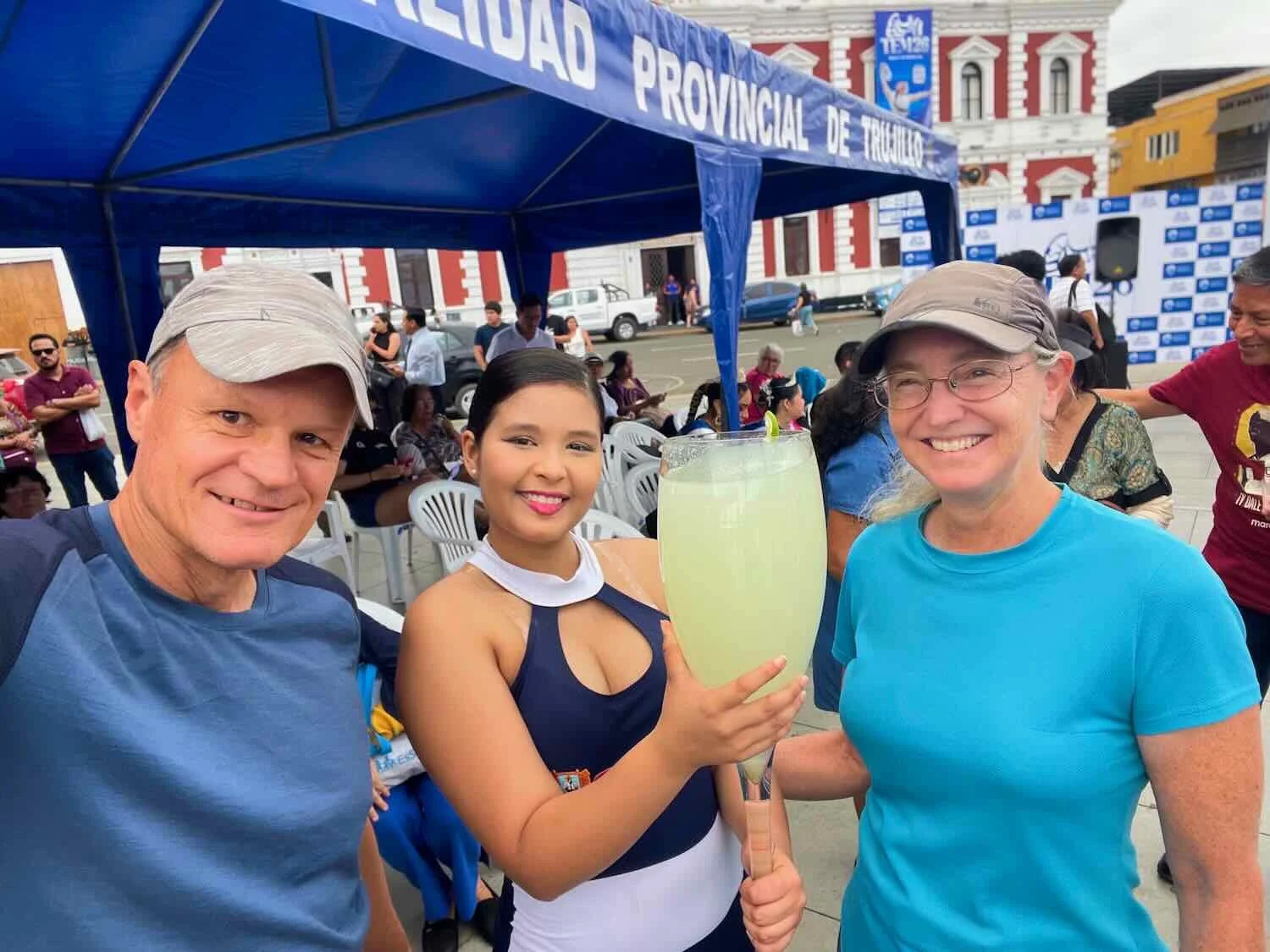
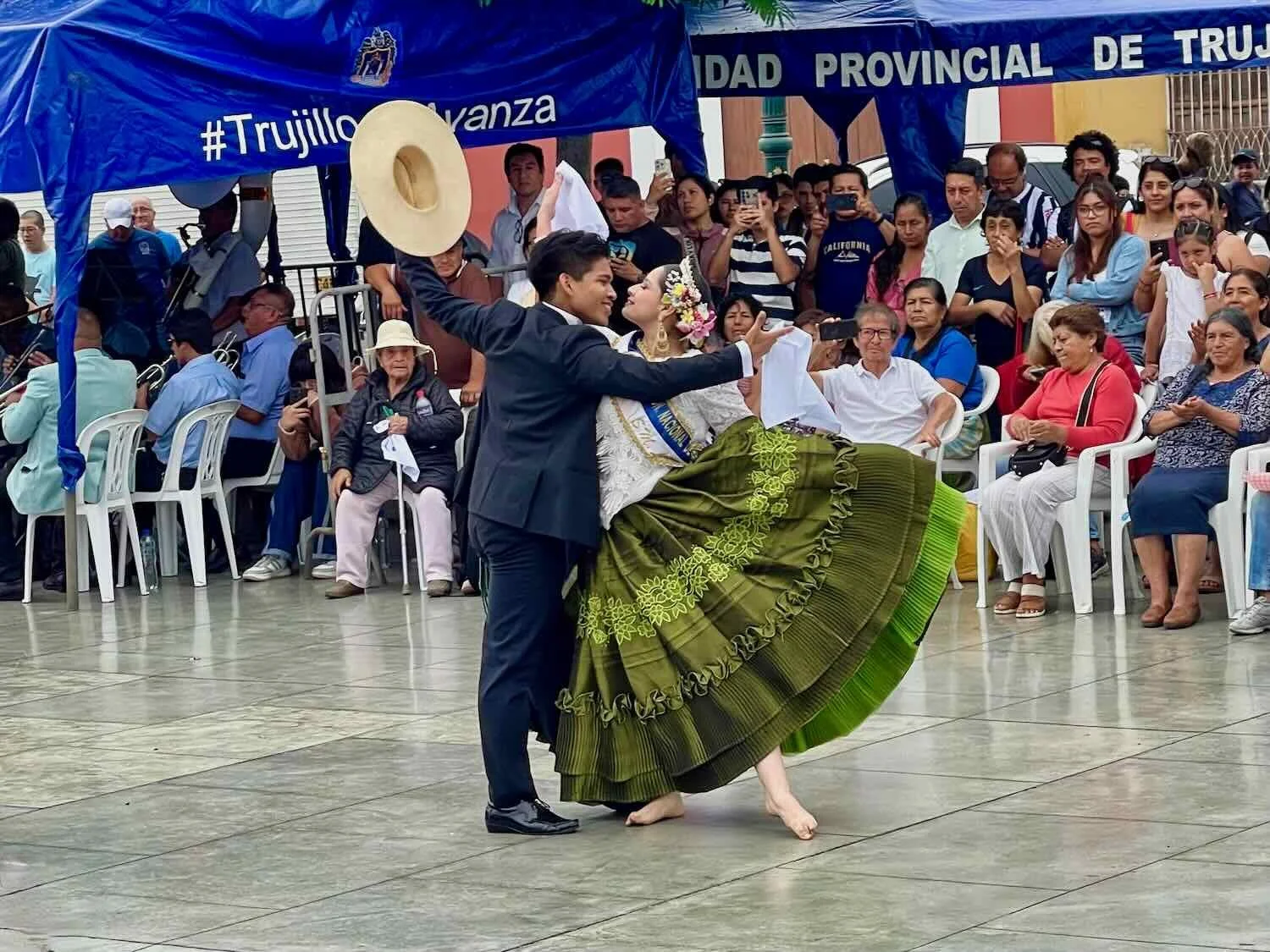
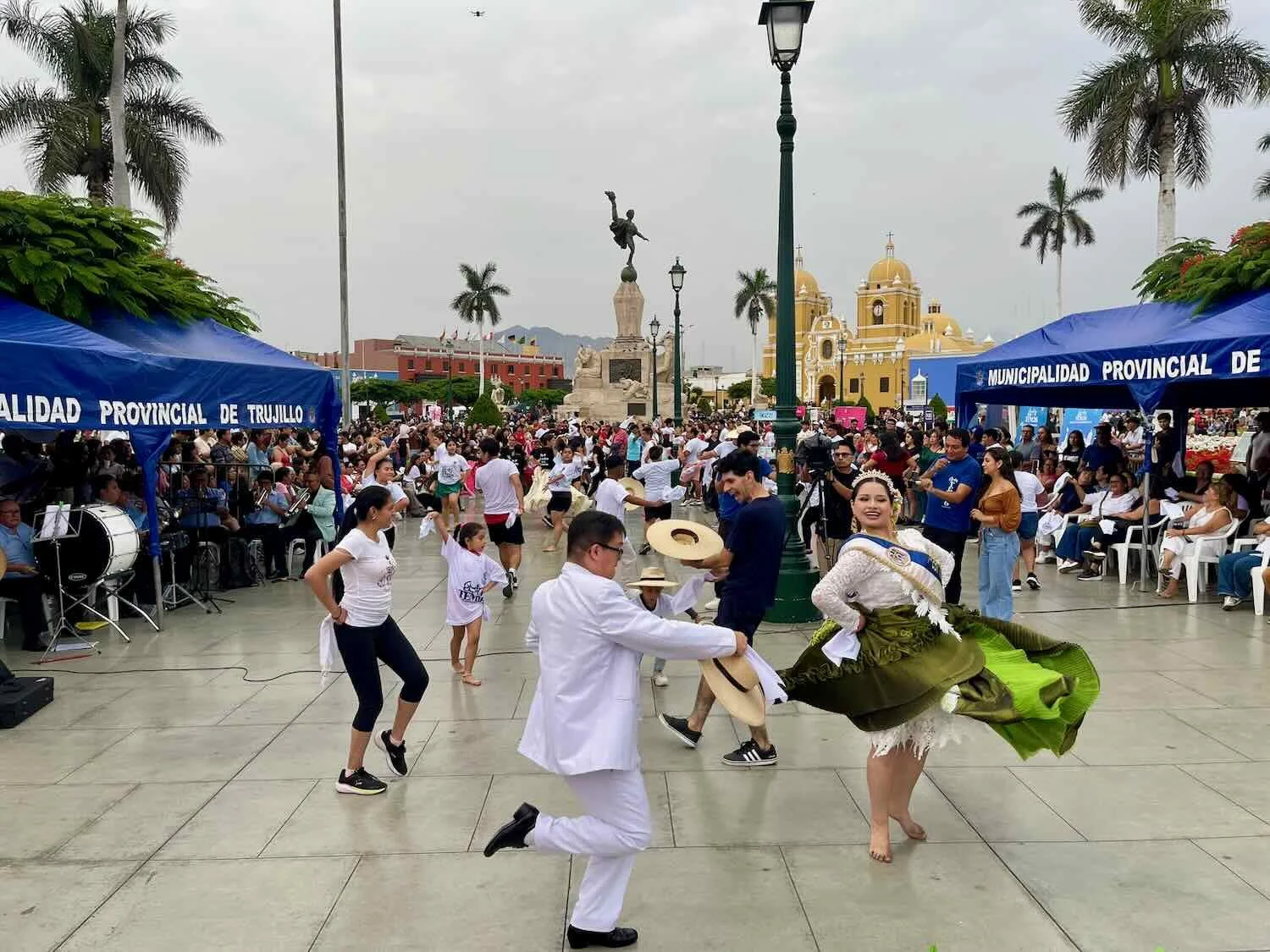
The residents of Trujillo like to throw a party, and there often were events held in the main plaza. We were fortunate enough to be in town for National Pisco Sour Day, as well as the National Marinera Festival. The pisco sour cocktail is actually Peru’s national drink, available on virtually every restaurant menu - and typically featured at happy hour. But one day a year, the cocktail gets all the glory, with tasting events and dancing throughout the country.
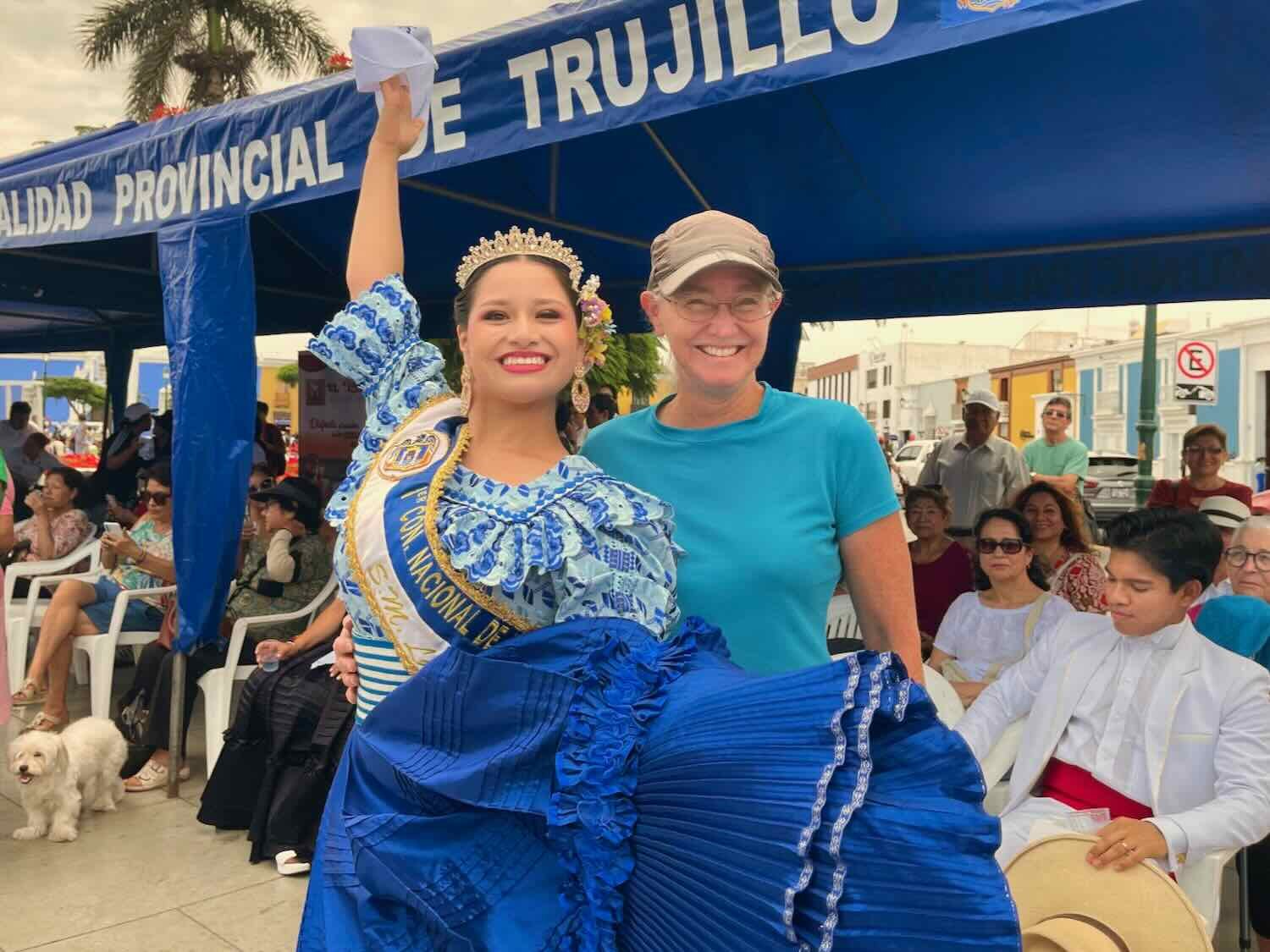
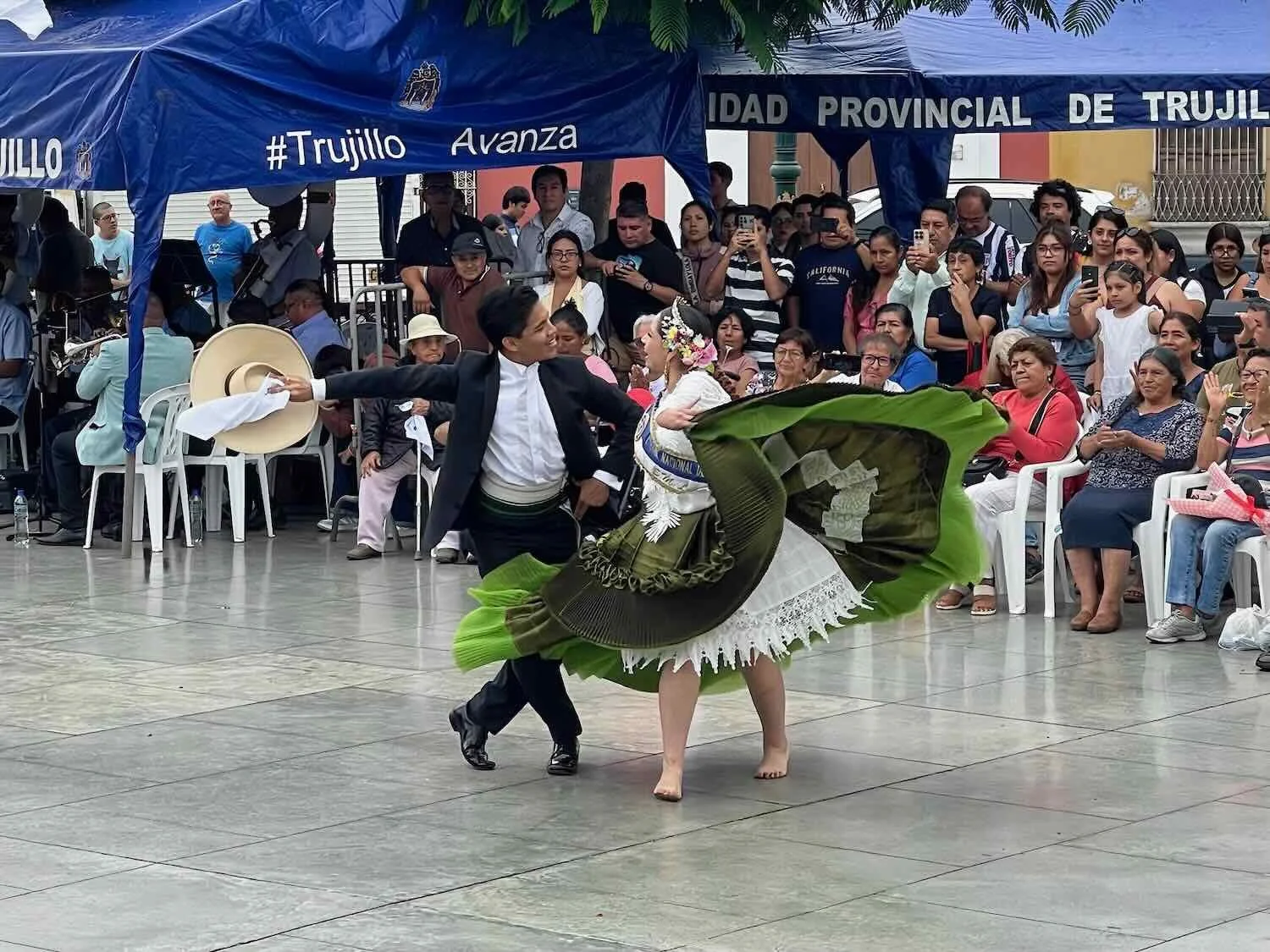
In keeping with the emphasis on national symbols, Trujillo is officially recognized as the birthplace of Marinera - Peru’s national dance. So you can imagine the excitement in the city when the National Marinera Festival comes to town. Throughout the week, couples show off their dancing skills in the main plaza, in a graceful display of romantic artistry. Classic motifs include twirling white handkerchiefs, flowing dresses, lots of face-to-face close-ups, and bare feet for the women. In addition to the public exhibitions, couples compete for national titles and regular folks from throughout the city show up for a chance to dance the Marinera with a professional. This festival was clearly a big crowd-pleaser.
A Peek Into the Past
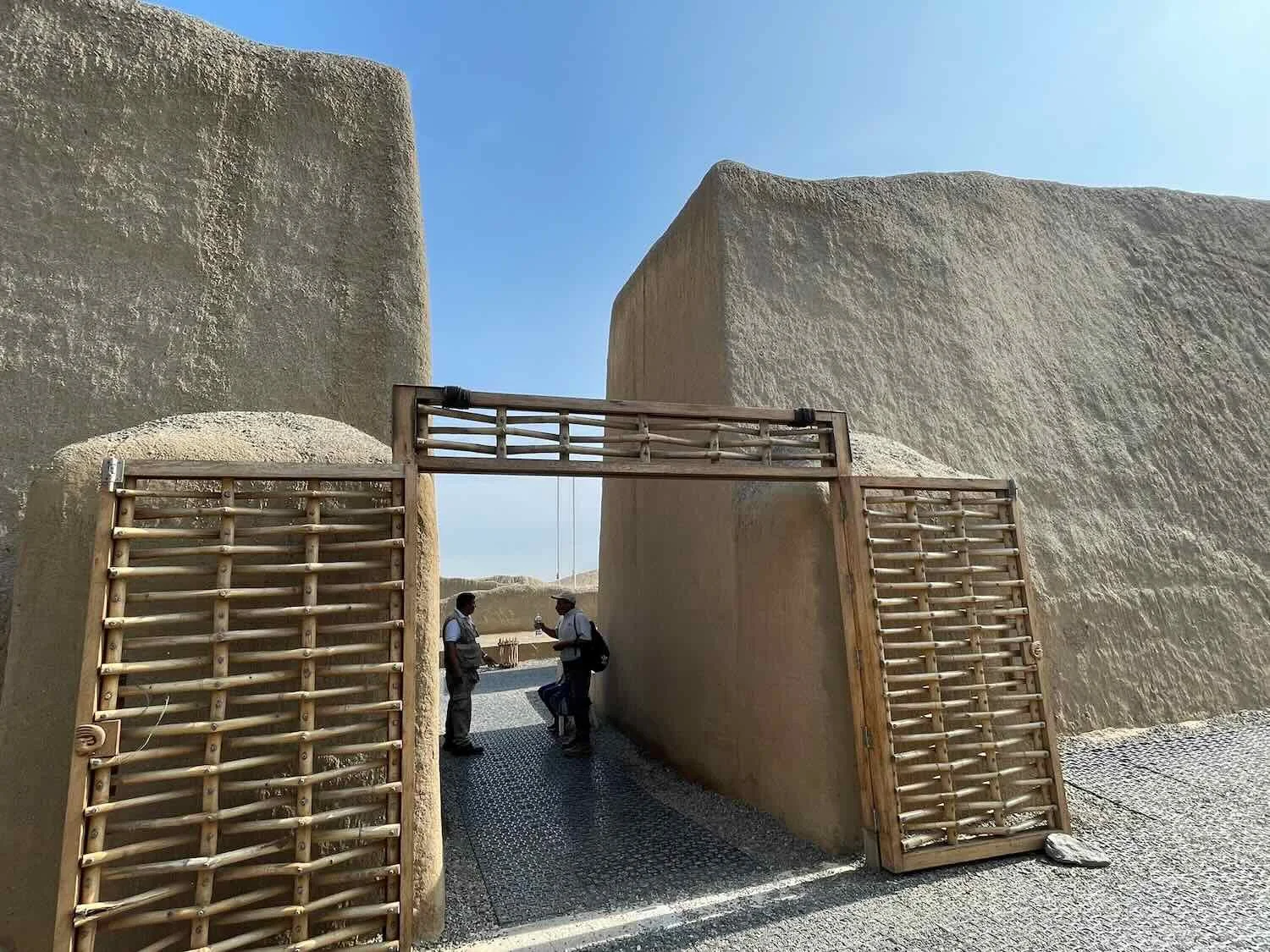
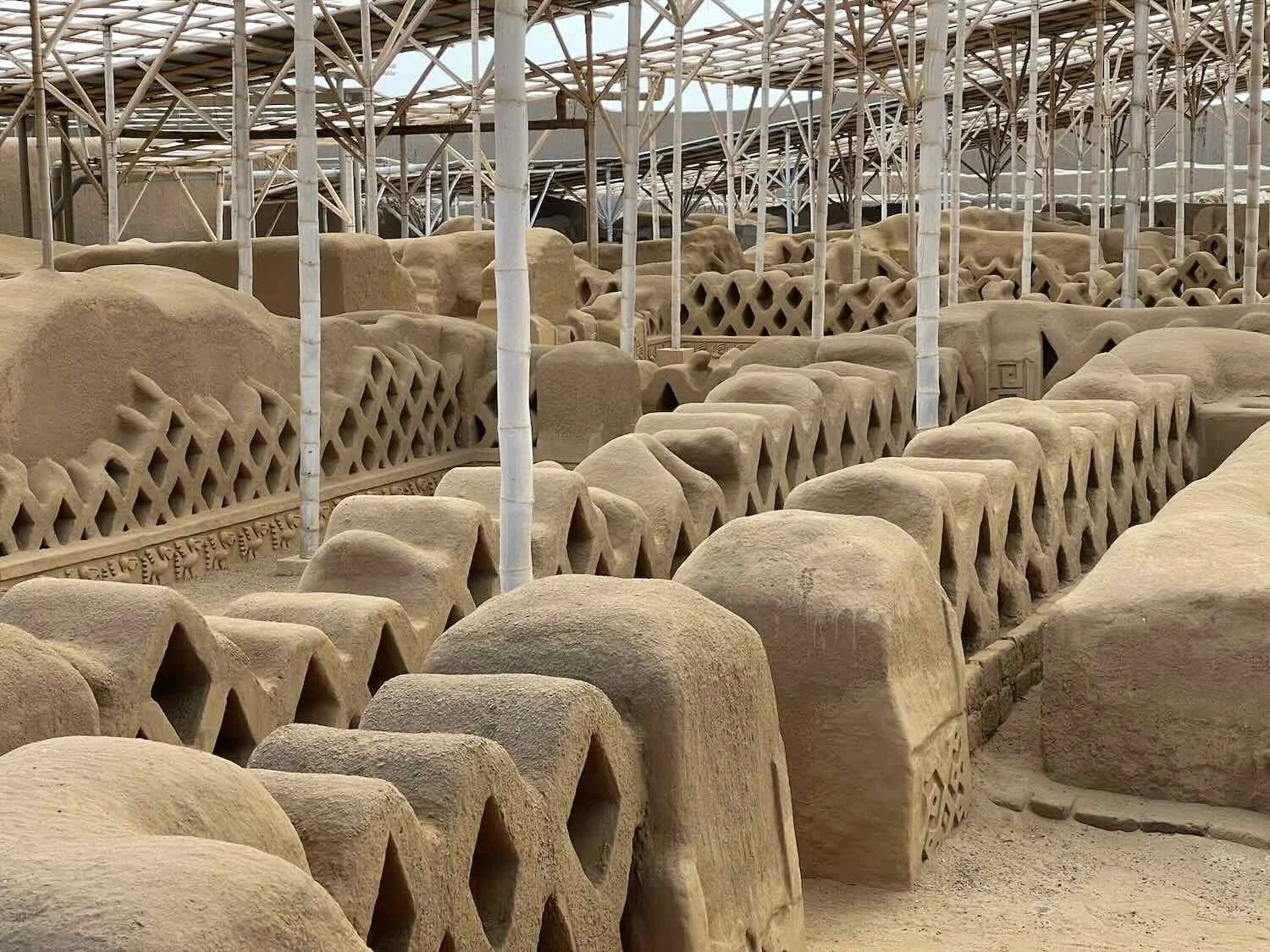
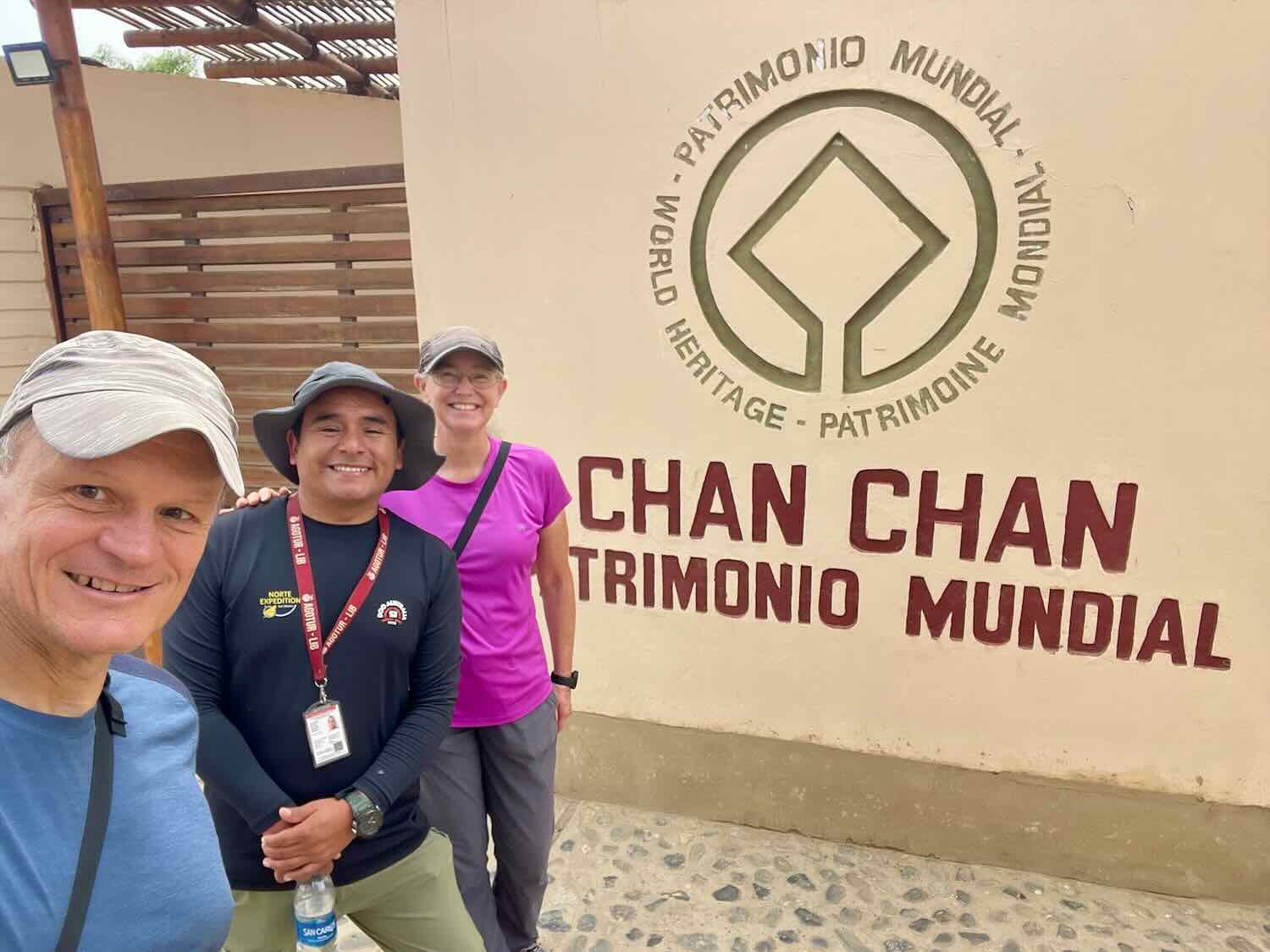
While in Trujillo we had to visit the famous archaeological site of Chan Chan, second only to Machu Picchu for its cultural significance in Peru. Constructed and occupied by the coastal Chimú people for more than 600 years, Chan Chan holds the record for being the largest pre-Hispanic adobe city in the world. At its height, Chan Chan covered more than 20 square kilometers (7.5 square miles), with massive adobe-walled compounds, residential neighborhoods and canal-irrigated fields. More than 40,000 people are believed to have lived there.
These days visitors are only able to visit a small area of the archaeological site, focused on a grand building called the Nik An Palace. Although the Spanish conquerors called these structures palaces, they were really more like administrative centers, with each new ruler building their own center (on his death, the previous ruler would be buried in his “palace”, and it would become a mausoleum). Our walk through Nik An took us through several plazas, leading from more open, public spaces to smaller, more private rooms in the back.
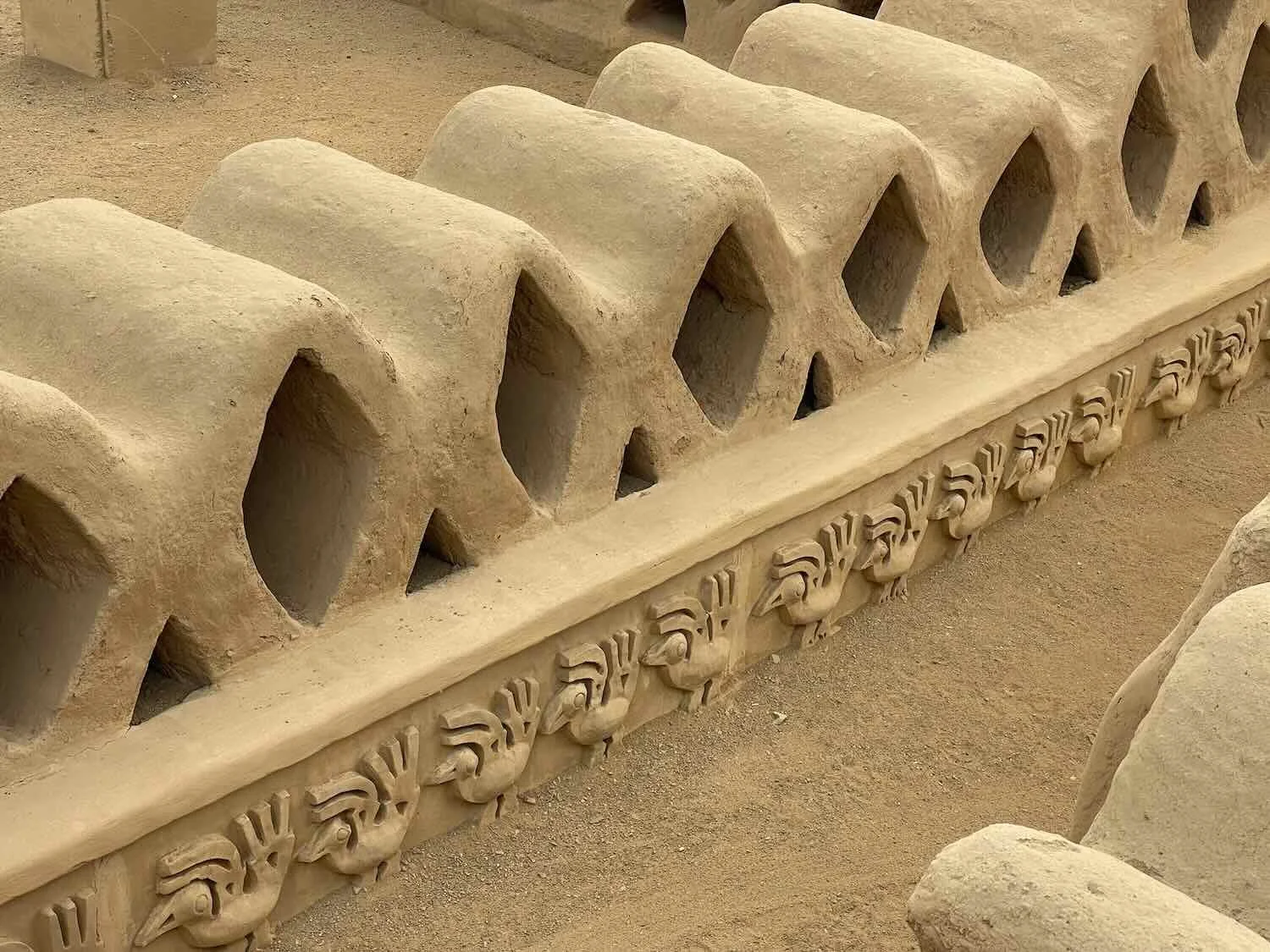
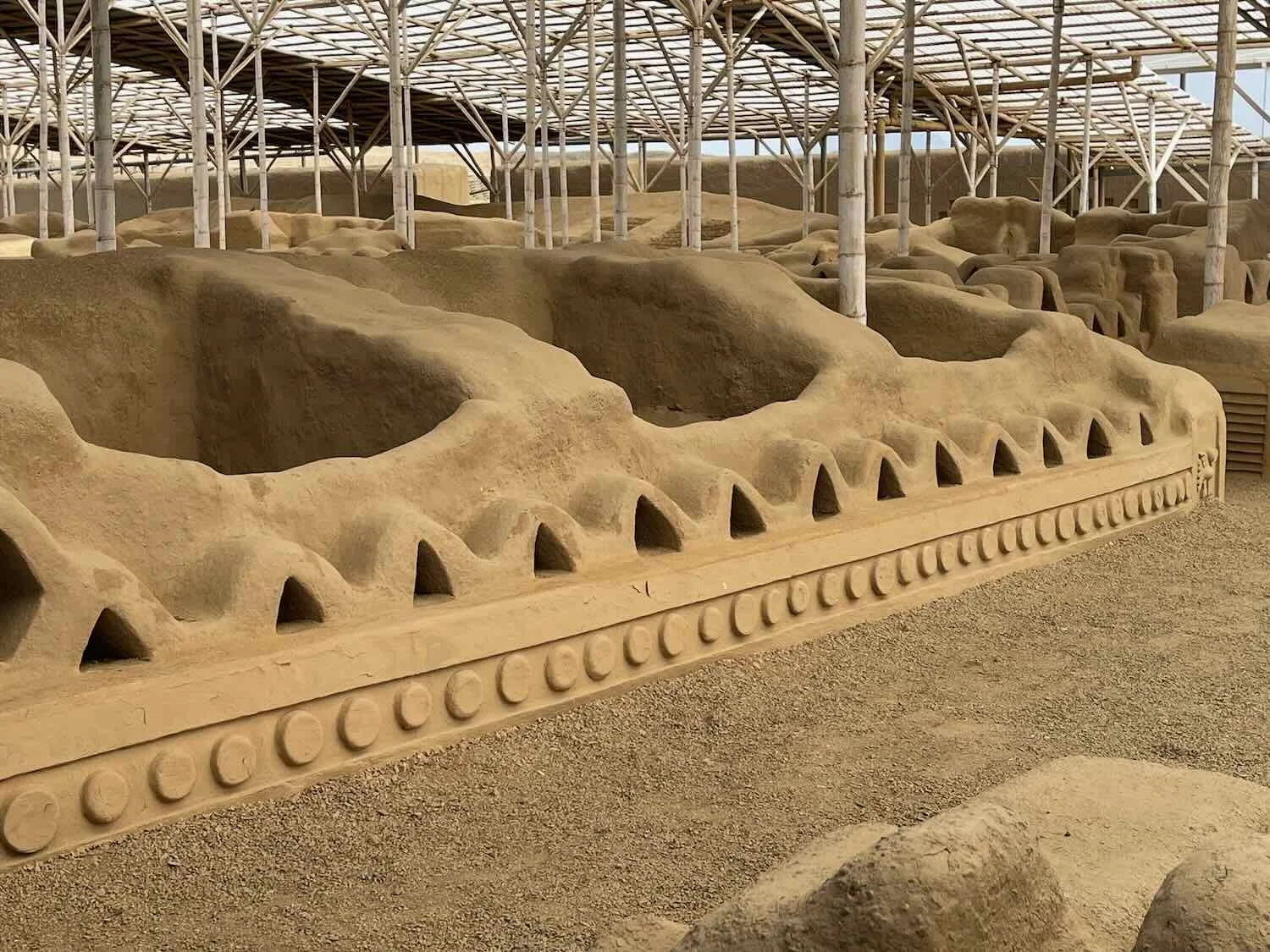
After touring the “palace” we walked over to the Huaca Toledo. Huacas were ceremonial pyramids that were accessed only by elite shamans or royalty to perform religious rites. Archaeological evidence suggests that the Huaca Toledo was a particularly important site for performing rituals that would be attended by the public, as a way to project royal authority.
The Huaca Toledo, a prominent, ritual pyramid built by the Chimú people. Chan Chan Archaeological Site, Trujillo, La Libertad Department, Peru. Copyright © 2019-2026 Pedals and Puffins.
The Chan Chan Archeological Site had gardens to illustrate the kinds of plants that would have been cultivated by the Chimú people - like this brown cotton. Trujillo, La Libertad Department, Peru. Copyright © 2019-2026 Pedals and Puffins.
Although we hadn’t originally planned to stay so long in Trujillo, we enjoyed our extended visit. The beautiful central plaza, lively commercial district, fascinating ancient history, and most of all, the generous and caring personality of the city’s residents combined to make our stay in the City of Eternal Spring extra special. Yet after nearly a month off our bikes, we were feeling the travel bug, and ready to get back on the road. We will always have fond memories of the days we spent exploring the treasures of Trujillo.
The Cathedral of Santa María added a stately elegance to the city’s central plaza (painted in the typical mustard yellow and white motif that was common for churches in this region). Trujillo, La Libertad Department, Peru. Copyright © 2019-2026 Pedals and Puffins.